
Virtual Mailbox, American Expats
Bank Rejected Your Virtual Mailbox Address? Here Is Why
Aug
A bank rejects a virtual mailbox address because federal Customer Identification Program rules require a residential or business street address for where you physically are, and address-verification software flags virtual mailboxes as Commercial Mail Receiving Agencies (CMRAs). The fix is usually simple and honest: give your true residential address as the physical address, and list the virtual mailbox separately as your mailing address.
Key Takeaways
- The rejection is about the physical address field, not about virtual mailboxes in general. Most institutions accept a CMRA street address as a mailing address.
- Your residential address must be where you actually live. At institutions that serve customers abroad, that can be a foreign address. Never claim to live somewhere you do not.
- A PO Box is never accepted as a physical address, and a CMRA street address is treated the same way for that one field.
- Web forms are blunt. A phone call or a branch visit often solves in ten minutes what the online form refuses to do at all.
- New accounts, brokerages, and app-only fintechs are the strictest. Accounts you already hold are the easiest to update.
- The best time to sort this out is before you move, while you still have a US residential address and a US phone number.
Table of Contents
- Why Did My Bank Reject My Virtual Mailbox Address?
- Mailing Address vs. Residential Address
- What a CMRA Flag Means
- What Each Type of Institution Typically Wants
- What to Do When You Get Rejected, Step by Step
- Which Accounts Are Stricter
- Scenarios for Americans Living Abroad
- How to Prepare Before You Move
- What People Get Wrong
- What a Virtual Mailbox Does Well for Banking
- Frequently Asked Questions
Why Did My Bank Reject My Virtual Mailbox Address?
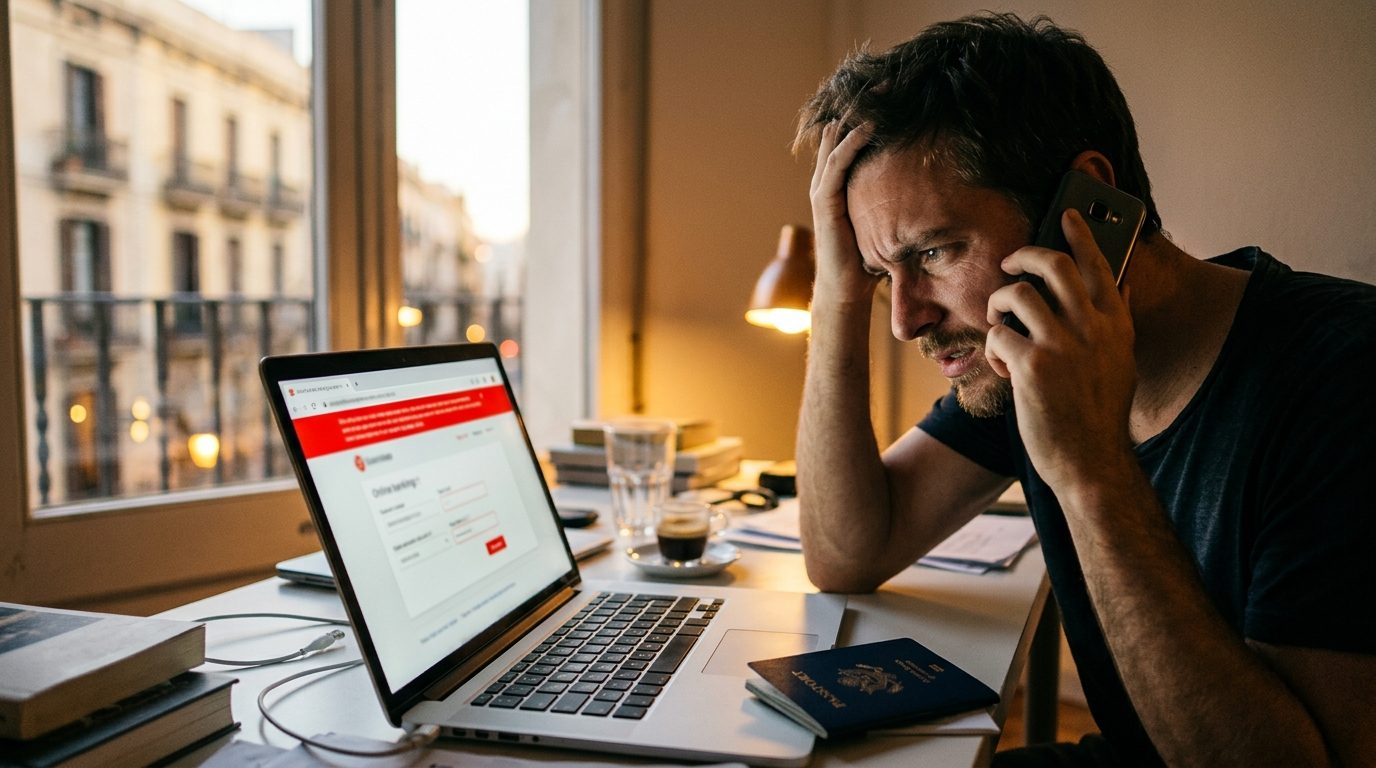
Your bank rejected it because you put a mail-receiving address in a field that, by federal rule, has to describe where you physically live or do business. The bank is not judging your mailbox provider. It is following its identification program, and the software enforcing that program does not make exceptions on a web form.
We run a CMRA in Tewksbury, Massachusetts, and this is one of the most common questions our subscribers bring us, usually right after a frustrating error message. The message is rarely helpful. It says something like “We could not verify your address” or “Please enter a residential address,” and then it stops. Here is what is going on behind it.
What the rule says
Since the USA PATRIOT Act, every US bank has to run a Customer Identification Program (CIP). Before opening an account for an individual, the bank must collect a name, a date of birth, an identification number, and an address. The regulation is specific about the address: for an individual it must be a residential or business street address. You can read the text yourself in the federal CIP rule for banks at 31 CFR 1020.220. Brokerages and credit unions work under parallel versions of the same rule.
A virtual mailbox is a real street address, but it is not your residence and it is not the place you run a business from. It is where your mail is received on your behalf. That is exactly the distinction the rule cares about.
How the bank knows
Nobody at the bank looked up your suite number by hand. When you submit an address, the bank’s system checks it against commercial address-verification data built on USPS records. Those records mark addresses that belong to a registered CMRA. The flag comes back in a fraction of a second, and the form rejects the entry or routes the application to manual review.
Why a PO Box never works either
A PO Box fails for the same reason, and it has failed for longer. Nobody lives in a PO Box, so it cannot be a physical address under any bank’s policy. People sometimes pick a virtual mailbox specifically because it is a street address and assume that gets them past this check. For carriers and most senders, the street address does make a difference, as we explain in virtual mailbox vs. PO Box. For the physical address field on a bank application, it does not.
Mailing Address vs. Residential Address
These are two different fields that answer two different questions, and nearly every rejection comes from mixing them up. The residential (or physical) address answers “where do you live?” The mailing address answers “where should we send your statements and cards?” A virtual mailbox is a legitimate answer to the second question only.
The residential address
This has to be true. It is the place you actually live, today. If you live in an apartment in Lisbon, your residential address is that apartment in Lisbon. If you live in a house in Lowell, it is the house in Lowell. Some US institutions are set up to hold accounts for customers with a foreign residential address and some are not. That is a business decision each institution makes, and it can change, so the only reliable source is the institution itself.
We will say this plainly because forum threads often say the opposite: do not list an address you do not live at as your residence. Not the mailbox, not a friend’s place, not the house you sold. A false statement on a bank application can get the account closed with little warning, and it can create far bigger problems than a rejected web form. If your situation is unusual, ask the bank what it will accept and let the bank make the call.
The mailing address
This is where paper goes: statements, replacement debit cards, new checkbooks, tax forms, fraud letters. Banks are generally comfortable with a mailing address that differs from the residential one, because millions of ordinary customers have one. Think of people with rural delivery problems, people who travel for work, students, and military families. A CMRA street address with your personal suite number fits here without any trouble at most institutions.
The same separation shows up in the mailbox paperwork itself. USPS Form 1583, which you complete to open any CMRA mailbox, asks for your home address in addition to the mailbox address. The postal system already treats “where you live” and “where your mail goes” as two separate facts. Your bank does too.

What a CMRA Flag Means
A CMRA flag is a marker in USPS address data showing that an address belongs to a Commercial Mail Receiving Agency, a private business registered with the Postal Service to accept mail for other people. It is a description, not an accusation. It tells the bank’s software “mail is received here for customers,” and nothing more.
Every legitimate mailbox provider carries this flag, including The UPS Store locations, independent pack-and-ship shops, and virtual mailbox companies of every size. We carry it too, and we would be operating outside USPS rules if we did not. Our plain-English explainer on what a CMRA is covers the registration and the customer paperwork in more detail, and the mail forwarding glossary defines the related terms.
Can a provider remove the flag?
No, and be careful with any company that hints it can. A provider advertising an “unflagged” or “residential-looking” address is either not registered as a CMRA, which puts your mail delivery at risk, or is describing something that will not last. Address data is refreshed constantly. An address that slips through today can be flagged next quarter, and then your bank is asking why your “home” turned into a mail center.
What the flag does not mean
It does not mean your mail is unsafe or that the address is fake. It does not block USPS, UPS, FedEx, DHL, or Amazon deliveries. It does not stop you from using the address with the IRS as a mailing address, with most retailers, or with most senders in your life. It only matters in the small number of places that need to know where your body sleeps: bank identity checks, some insurance underwriting, driver’s licenses, and voter registration.
What Each Type of Institution Typically Wants
There is no master list of which bank accepts what, and any list you find online is out of date by the time you read it. What stays consistent is the pattern by type of institution. Use this table as a starting point and confirm with the institution before you rely on it.
| Institution or situation | Physical address typically required | CMRA as mailing address | What usually works |
|---|---|---|---|
| Existing checking or savings account at a traditional bank | True residential address already on file, updated when you move | Usually accepted | Call or visit, update residential honestly, add the mailbox as mailing address |
| New account at a traditional bank | US residential or business street address in most cases | Usually accepted once the account is open | Open it while you still live in the US, or apply in a branch with documents |
| Credit union | Residential address, often tied to the membership area | Often accepted | Ask about membership rules for members who relocate |
| Brokerage or retirement account | Legal residential address, with country of residence recorded | Often accepted for correspondence | Ask what happens to the account for residents of your destination country |
| App-only fintech or neobank | US residential address, verified automatically | Varies, often no separate field | Little flexibility; contact support or choose a different institution |
| Credit card issuer | Residential address for the application | Usually accepted for statements and card delivery | Apply before you move, then update both addresses honestly |
| Business account for an LLC or corporation | Business street address plus the owners’ residential addresses | Usually accepted for mail | Bring formation documents and explain where the business operates |
Notice how often the right column says some version of “talk to a person.” That is not a coincidence, and the next section explains why.
What to Do When You Get Rejected, Step by Step
Stop resubmitting the web form, pick up the phone, and separate the two addresses. Most rejections clear up once a human at the bank enters your true residential address in one field and your mailbox in the other. Here is the order we suggest to subscribers.
- Do not retry the form with variations. Swapping “Suite” for “Apt” or “Unit” does not fool the address data, and repeated failed attempts can lock the application or trigger a fraud review. Writing the suite as an apartment is also a misstatement. Leave it alone.
- Look for a separate mailing address option. Many forms hide it behind a checkbox such as “My mailing address is different.” If it exists, the form is telling you exactly what it wants: residence in the first block, mailbox in the second.
- Call, or go to a branch if you can. Online forms apply the strictest version of the policy because no one is there to ask a follow-up question. A banker can see both fields, understands customers who travel or live abroad, and can add notes to your profile.
- Give your true residential address. If it is a US address, give that. If you live abroad, say so and give the foreign address. Ask directly: “Do you maintain accounts for customers who live outside the US?” It is better to hear the answer now than after a surprise account review.
- Add the virtual mailbox as the mailing address. Give the full street address with your suite number, formatted exactly as your provider gave it to you.
- Have documents ready. Banks commonly ask for government photo ID and proof of the residential address, such as a lease, a utility bill, or an official letter. For the mailbox, your service agreement or a copy of your completed Form 1583 shows why mail goes there.
- Ask for the change to be noted. A note on the profile saying “customer resides at X, receives mail at CMRA address Y” saves you from explaining it again in six months.
- If the answer is still no, move on cleanly. Some institutions will not serve your situation. Thank them, keep the account you have in good standing, and look for an institution whose policy fits. Our guide to keeping a US bank account while living abroad covers what to ask when you shop around.
If you believe a bank handled your account unfairly, the Consumer Financial Protection Bureau takes complaints at consumerfinance.gov. It will not force a bank to accept a CMRA as a residence, because the bank is right on that point, but it is the proper channel for problems like frozen funds or an account closed without explanation.
Which Accounts Are Stricter
New accounts are stricter than existing ones, and fully automated institutions are stricter than those with staff you can talk to. The reason is simple: the identification rules apply with full force at account opening, and software cannot use judgment.
New accounts
Opening is the moment the bank must verify who you are. An applicant with no history, a flagged address, and perhaps a foreign IP address looks identical to a fraud attempt from the software’s point of view. An existing customer of twelve years who calls to add a mailing address looks like what she is: a customer who is moving.
Brokerages and retirement accounts
Investment firms care a great deal about your country of residence, because securities rules in your new country can limit what a US firm may offer you. Some firms restrict trading or certain products for customers abroad, and a few close accounts. A mailing address does not change any of that, and hiding your residence to avoid it is the kind of misstatement that ends badly. Ask the firm for its policy on your specific country, in writing if possible.
Fintechs and app-only banks
These are often the least flexible. There is no branch, support is by chat, and the signup flow usually has a single address field that must pass automated verification. If the app has no separate mailing address field, there may be no way to use a CMRA address at all, and no person with the authority to override it.
Credit cards
Card applications run an identity and credit check against your residential address history. After approval, issuers are usually relaxed about where the statements and replacement cards go. We cover the card side, including foreign transaction fees and keeping cards active, in US credit cards while living abroad.
Scenarios for Americans Living Abroad
Most expats can keep their US banking working with a truthful foreign residential address on file and a US mailing address for paper. The details depend on when you ask and whom you bank with. These are the situations we see most.
You already moved and the bank still has your old US home
This is the most common case. The house is sold or the lease is over, and your records still show it. Mail may be bouncing back to the bank, which is a quiet way to get an account restricted. Call, tell them where you live now, and set the mailbox as the mailing address. Banks deal with relocating customers every day. What worries them is returned mail and addresses that do not make sense.
You want to use a relative’s address
As a mailing address, with their permission, that is your choice, though it turns your sister into your unpaid mail clerk. As your residential address, it is only honest if you really live there. The CIP rule does mention a next of kin or contact person’s address for individuals who have no residential or business street address, but whether that fits your circumstances is for the bank to decide after you explain the facts. We compare the practical trade-offs in family address vs. virtual mailbox for expats.
You move often and have no fixed home
Long-term travelers and digital nomads have the hardest version of this problem, because “where do you live” has no tidy answer. Do not invent one. Explain your situation to the bank, ask what it accepts, and expect that some institutions will say they cannot help. State residency and domicile questions sit underneath this, and we outline them in our piece on state residency, taxes, and your mail. Confirm your own position with a tax professional.
You are not a US citizen and need a first US account
A US mailing address helps with correspondence, but it will not substitute for the residential address and identification a bank requires from a non-resident applicant. Some banks open accounts for non-residents with a passport and a foreign address, often in person. Start with how to get a US address so you understand what the address can and cannot do before you apply.
Your tax forms
Banks also use your address and residency status for tax reporting. A US citizen abroad generally remains a US person for tax purposes regardless of the residential address on file, but the forms your bank asks for can change. The IRS publishes guidance for taxpayers abroad at irs.gov. Confirm the specifics with a tax professional.
How to Prepare Before You Move
Do your banking setup while you still have a US residential address, a US phone number, and the ability to walk into a branch. Everything is easier from inside the country. Here is the sequence we recommend, ideally starting two or three months before departure.
- Open any accounts you will want later, now. A second checking account, a no-foreign-fee credit card, a brokerage account. Applying as a current US resident is truthful today and may not be possible from abroad.
- Open your mailbox and finish Form 1583 early. Online notarization is accepted, but doing it before you are packing boxes is calmer. Compare options on our virtual address and mailbox rental pages.
- Add the mailbox as the mailing address on every account. Do this before you leave, and watch for one statement cycle to confirm mail is arriving.
- Tell each institution you are moving. Ask what it needs from customers abroad, and whether any products are restricted in your destination country.
- Update the residential address after you move. When the new home exists, give it to the bank. Keep a copy of your foreign lease or a utility bill for when someone asks.
- Sort out your phone number. One-time passcodes by text are the other thing that locks expats out. Ask each bank which verification methods work overseas.
- Keep a simple record. A one-page list of institutions, the addresses each has on file, and the date you last confirmed them. It takes twenty minutes and saves hours.
The broader paperwork list, from the DMV to your voter registration, is in our moving abroad mail and document checklist. If you are still deciding whether the address is worth having at all, read do I need a US address living abroad first.
What People Get Wrong
Most of the bad advice on this topic comes from treating the rejection as a technical obstacle to get around, instead of a question to answer truthfully. These are the mistakes we hear about most often.
- “A virtual mailbox gives me a US residential address.” It gives you a real US street address for mail and packages. It does not give you a residence, and no honest provider says it does.
- “I’ll just write the suite number as an apartment.” The address data flags the building, not the word in front of your number. You gain nothing and you have now misdescribed your address on a bank form.
- “The rejection means virtual mailboxes are useless for banking.” The opposite is closer to true. The mailing address is where your replacement card, your checks, and your fraud notices go. That is the part that fails when you live abroad without one.
- “If I tell the bank I live abroad, they will close my account.” Some institutions do not serve customers abroad, and it is better to learn that on your schedule. Many do. Accounts that get closed abruptly are more often the ones with returned mail, logins from unexpected countries, and an address that no longer adds up.
- “Some forum user listed banks that accept CMRA addresses.” Those lists describe what one form accepted on one day. Policies and address data change. Ask the institution.
- “I need a provider whose address is not flagged.” You need a provider that is properly registered and will still be at that address in ten years. The flag comes with being legitimate.
What a Virtual Mailbox Does Well for Banking
Used as a mailing address, a virtual mailbox solves the problems that actually cost expats money: cards that never arrive, checks that sit for months, and notices with deadlines that nobody reads. That is the job it is built for.
Think about what your bank still sends on paper. Replacement debit and credit cards when the old ones expire or get compromised. New checkbooks. Year-end tax forms from institutions that have not gone fully digital. Letters asking you to verify something within 30 days. If those go to a house you sold, the first sign of trouble is a declined card at a checkout counter in another country.
At a staffed mailbox, each item is logged and you get a free email alert when it arrives. With mail scanning, a bank letter becomes a PDF you can read and act on from anywhere. Scanning is included free on the Silver Plan at $450 per year and the Gold Plan at $595 per year, and is a paid add-on with the Starter Plan at $330 per year. A physical card can go out by tracked courier to your foreign address through our mail forwarding service, to any of 220+ countries and territories. Government mail has its own quirks, which we cover in IRS and Social Security mail while living abroad.
When the free option is the right call: if you are abroad for a single semester, your bank is fully paperless, and a parent is happy to open the occasional envelope, you may not need a mailbox at all. If you will be gone for years, or your relative’s patience has limits, a stable address that belongs to you is the cleaner arrangement. Plan details are on the plans and pricing page.
Frequently Asked Questions
Can I use a virtual mailbox for my bank account?
Yes, as your mailing address. Most banks accept a CMRA street address for statements, cards, and notices. You cannot use it as your residential or physical address, because federal identification rules require the place you actually live or do business. Put your true residence in one field and the mailbox in the other.
Why does my bank say my address is a CMRA or commercial address?
The bank checks every address against verification data built on USPS records, and those records mark addresses registered as Commercial Mail Receiving Agencies. Every legitimate virtual mailbox and mailbox store carries that marker. It means mail is received there for customers. It does not mean the address is fake or unsafe.
Can I list a foreign address as my residential address with a US bank?
At institutions that serve customers living abroad, yes, and it is the honest answer if that is where you live. Policies differ between institutions and can change, so ask yours directly. Some will keep existing accounts open but will not open new ones for customers with a foreign residence.
Will changing the suite number to an apartment number get past the check?
No. Address verification flags the building’s street address, not the word before your number, so the form still fails. You would also be misdescribing your address on a bank document. Repeated failed attempts can lock the application or trigger a fraud review. Call the bank and use the separate mailing address field.
Is there a virtual mailbox address that banks will not flag?
Not a legitimate one. Any provider properly registered with USPS as a CMRA appears in the address data. A provider promising an unflagged address is either unregistered, which puts your mail delivery at risk, or relying on data that will catch up. Choose a registered, staffed provider and use the address for mail.
Is a PO Box better than a virtual mailbox for banking?
No. A PO Box is never accepted as a physical address either, and it cannot receive UPS, FedEx, or DHL deliveries, which is how many banks ship replacement cards internationally or on rush orders. A staffed CMRA street address accepts every carrier and can scan or forward what arrives.
What documents should I have ready when I call the bank?
Have a government photo ID, proof of your residential address such as a lease or utility bill, and your mailbox details formatted exactly as your provider gave them. A copy of your completed USPS Form 1583 or your mailbox service agreement helps explain why your mail goes to a different address than your home.
Give the Bank the Truth and Give Your Mail a Home
A rejected address is a five-minute problem once you know which field it belongs in. Tell the bank where you live, tell it where to send your mail, and make sure the second address is staffed, registered, and going to be there for the long run. Ours has been at the same counter in Tewksbury, Massachusetts since 2007, open Monday through Friday, 9:00 AM to 5:30 PM Eastern, with a background-checked team handling every envelope in-house.
Compare mailbox plans, or contact us with questions about how your address should be formatted for a bank or card issuer before you apply.
