
American Expats, Virtual Mailbox
How to Keep Your US Bank Account While Living Abroad: The Expat Playbook
Jul
You keep a US bank account while living abroad by maintaining a US mailing address, a US phone number, and clean account activity, and by handling your bank mail so nothing important goes unanswered. The single most common trigger for account restrictions is a foreign address appearing on file. This playbook covers why banks react to foreign addresses, how to set up your address before you move, what to do about statements and replacement cards, and what to check with your specific bank, because policies vary by institution.
Table of Contents
- Why Your US Account Matters More Abroad
- Why Banks React to Foreign Addresses
- Step 1: Establish a US Mailing Address Before You Move
- Step 2: Update Accounts in the Right Order
- Step 3: Handle Bank Mail From Abroad
- Step 4: Keep a US Phone Number for Verification
- Step 5: Keep the Account Alive and Clean
- The Honesty Question: Address vs. Residence
- The Pre-Departure Checklist
- Frequently Asked Questions
Why Your US Account Matters More Abroad
Closing your US bank account when you move overseas creates problems that follow you for years. US credit history goes stale without active accounts. IRS refunds and Social Security payments want a US deposit destination. US brokerages often restrict or close accounts with no US footprint. Rent from a US property, payments from US clients, and transfers to family all run through US rails. And if you ever move back, rebuilding banking relationships from zero takes years.
Over 9 million Americans live outside the United States, and nearly all of them keep at least one US account open. The ones who succeed treat their US address and mail handling as infrastructure, set up before departure, not patched together after a scare.
Why Banks React to Foreign Addresses
Banks are not being difficult for sport. A foreign address on a US consumer account raises three real issues on their side.
Regulatory scope. Serving residents of another country can pull a US bank into that country’s licensing and reporting requirements. Many banks simply decline to serve foreign-resident customers rather than carry that burden, and their systems flag foreign addresses automatically.
Fraud models. Address changes to foreign destinations score high in fraud detection. A sudden switch from Ohio to overseas can freeze cards until you verify identity, at exactly the moment you are hardest to reach.
Deliverability. Banks send legally required notices, replacement cards, and checks. International delivery is slow and unreliable, and returned mail triggers account review.
Every one of these problems is an address-and-mail problem. Which means every one of them has an address-and-mail solution.
Step 1: Establish a US Mailing Address Before You Move
You need a US address that receives mail continuously, forwards or scans it on demand, and stays valid for years. Three options people try:
A relative’s house. Free, and workable until it is not. Your mail mixes with theirs, important letters sit unopened during their vacations, and every scan request is a favor. Relationships and mail volume both strain.
A PO Box. Wrong tool. No street address format, no private-carrier deliveries, and someone still has to physically collect the mail. Many bank systems also reject PO Box formats for primary addresses.
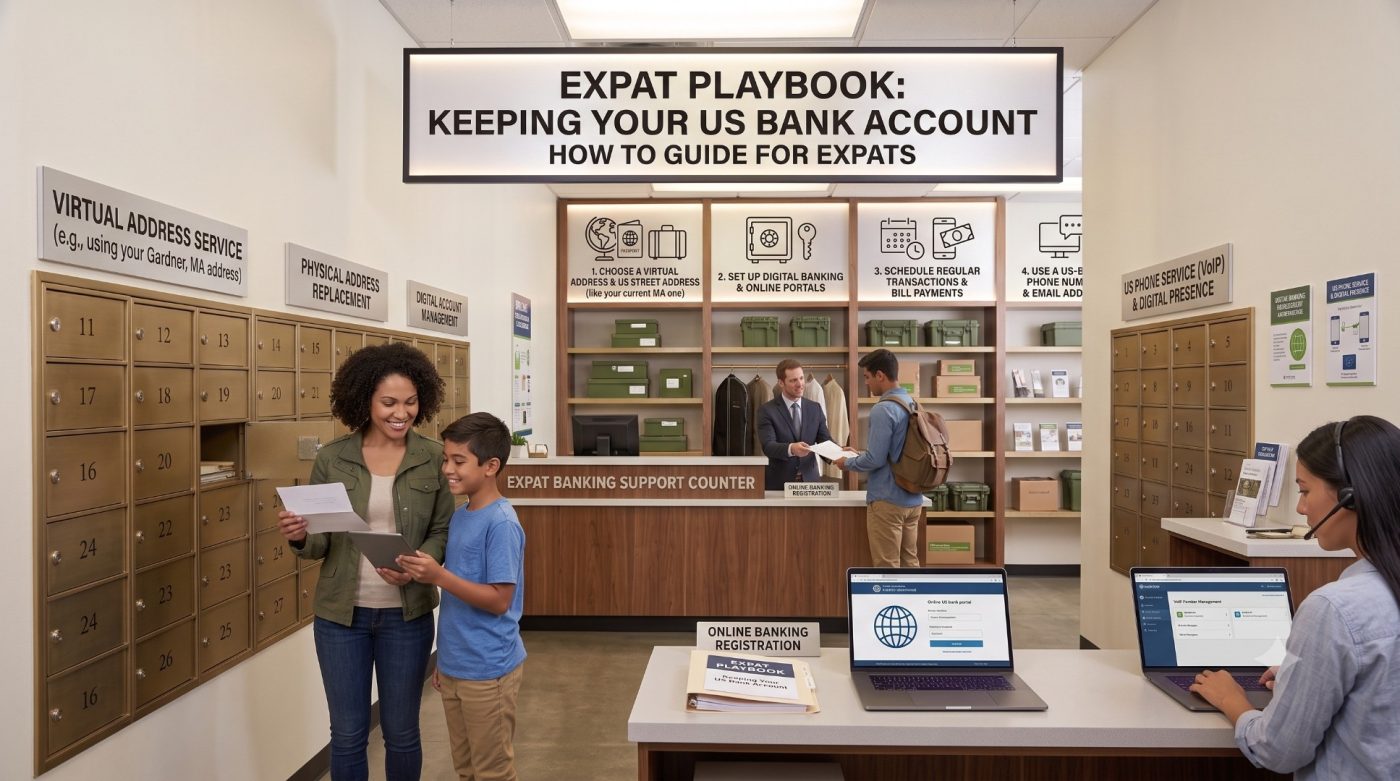
A virtual mailbox at a staffed CMRA. Built for the job. You get a real Massachusetts street address, every arrival triggers an email alert, and you decide remotely whether to scan, forward, hold, or shred. The address never expires and works identically whether you are in Lisbon or Bangkok. Read what a CMRA is and how mail forwarding works for the mechanics.
Set this up 60 to 90 days before departure. You want the address live, tested, and receiving mail while you are still in the US to fix anything that needs fixing. The paperwork step is USPS Form 1583, which takes 20 minutes.
Step 2: Update Accounts in the Right Order
Update addresses while you still have your US phone number active and can receive verification texts easily. Recommended order:
- Primary bank accounts. Update the mailing address through online banking. Do it weeks before departure so any verification happens while you are reachable.
- Credit cards. Same process. Cards expire and get reissued, and the replacement needs somewhere safe to land.
- Brokerage and retirement accounts. These are the most sensitive to foreign residence. Update the mailing address and read your custodian’s policy before you go.
- IRS. File Form 8822 to change your address, or update it on your next return. IRS letters are the last mail you want bouncing.
- Everything else. Insurance, DMV where applicable, subscriptions, loyalty programs. Then file a USPS change of address from your old home to your new mailing address to catch stragglers; our guide on USPS vs. private mail forwarding explains the sequence.
Step 3: Handle Bank Mail From Abroad
Even with paperless billing, banks still send physical items: replacement debit and credit cards, PIN mailers, tax forms, legal notices, and occasionally paper checks. The handling pattern that works:
Scan the routine. A notice arrives, you get the arrival alert, request a content scan, and read the PDF the same day. No waiting for international delivery for a letter that needed two minutes of attention.
Forward the physical. Replacement cards and documents you physically need get forwarded to wherever you are, by tracked carrier, on your instruction. Batch them with other items to save on shipping; consolidation cuts international costs 30% to 40% per batch.
Shred the noise. Marketing mail dies in the shredder without crossing an ocean.
This is the difference between an address that merely exists and mail that is actually handled. Full details on plan options are on our subscription plans page.
Step 4: Keep a US Phone Number for Verification
Two-factor codes and fraud-verification calls go to US numbers. Port your number to a VoIP service or keep a low-cost US plan alive. Do it before you leave, while carrier stores and verification texts are easy. A US address plus an unreachable phone still leaves you locked out of your own account at the worst moment.
Step 5: Keep the Account Alive and Clean
- Keep regular activity flowing: a deposit, a payment, an autopay. Dormant accounts attract review and state escheatment clocks.
- Log in periodically and keep online statements enabled.
- Avoid patterns that look like fraud: no long silence followed by a large foreign transfer. Ramp activity normally.
- Report your foreign financial accounts as required. US persons with foreign accounts above thresholds file FBAR and possibly other forms. Tax and reporting obligations vary by situation, so confirm yours with a qualified tax professional.
The Honesty Question: Address vs. Residence
Handle this cleanly. A mailing address and a residence are different fields, and banks may ask for both. Your Massachusetts street address is a legitimate mailing address, the place you receive mail, and presenting it that way is honest and standard practice for millions of Americans abroad. If your bank asks specifically where you reside, answer truthfully. Some institutions serve foreign-resident customers without issue, some restrict certain products, and policies change. What gets accounts closed is misrepresentation, not living abroad.
Where residence policy becomes a problem with one institution, expat-friendly banks and credit unions exist precisely for this market. The stable US mailing address remains valuable in every scenario, because statements, cards, and notices still need a reliable US destination. State tax residency is a separate topic with its own rules; our guide on state residency, taxes, and your mail setup covers it.
The Pre-Departure Checklist
- Open your virtual mailbox and complete Form 1583 (60 to 90 days out).
- Update bank, card, brokerage, and IRS addresses to the new US address.
- Port your US phone number to VoIP or a keeper plan.
- Enable paperless statements everywhere, with the paper backstop handled by scanning.
- Set up autopays so activity continues without you.
- File the USPS change of address from your old home to the new mailing address.
- Test one scan and one forward before you fly.
- Note your bank’s foreign-residence policy in writing, so there are no surprises.
Account-by-Account: What Each Institution Type Cares About
Banks are not one policy. Each account type has its own sensitivities, and knowing them prevents the wrong surprise.
Checking and savings
The workhorse accounts care most about deliverable mail, working phone verification, and activity. Keep all three healthy and most retail banks stay quiet for years. The riskiest moment is a stale account with a bounced statement: dormancy review plus returned mail is the classic closure recipe. An autopay, a monthly transfer, and a monitored mailing address remove the recipe’s ingredients.
Credit cards
Cards add two wrinkles: expiration cycles and fraud sensitivity. Every renewal cycle mails plastic to your address on file, which is exactly what same-day arrival alerts and tracked forwarding exist for. Foreign transaction patterns are normal to issuers these days, but a travel notice in the app before big location changes still smooths the ride. Keep at least one US card active with small recurring charges; a card that never transacts is a card flagged for review, and US credit history rewards continuous use.
Brokerages and retirement accounts
The strictest category. Securities rules make some custodians restrict trading, new purchases, or entire accounts for customers they classify as foreign residents, and policies differ sharply between firms. Before you move, read your custodian’s policy in writing, and if it is hostile, transfer to a firm that documents its openness to US expats. Do the transfer while stateside; moving an IRA between custodians is paperwork you want done from a stable address with easy phone verification. Your mailing address keeps statements and tax forms flowing either way.
Credit unions and online banks
Often the friendliest combination for expats: membership-based institutions with mission-driven service, and online-first banks whose entire model assumes you never visit a branch. Several subscribers keep a big-bank account for cash logistics plus an online bank for daily use, all pointed at the same Massachusetts address. Redundancy is cheap; being unbanked from abroad is not.
Protecting Your US Credit While Away
Credit history quietly decays abroad if every US account goes dormant. The maintenance routine costs minutes per month: keep two or more cards open with small automated charges and autopay in full, keep utilization low, and never let the oldest card close for inactivity. Check your reports periodically through the official annual report channel, and consider a credit freeze at the three bureaus while abroad, which blocks new-account fraud without touching existing accounts. Your mailing address matters here too: bureau correspondence and any dispute paperwork need a reliable US destination, and identity-verification letters routinely refuse foreign addresses. Returning expats who kept two cards humming and a clean address trail walk back into US financial life without a gap; the ones who went dark spend a year rebuilding scores they already earned once.
The Recovery Playbook: When an Account Freezes Anyway
Even good setups hit turbulence. A fraud model misfires, a verification letter goes out, a card locks mid-purchase. From nine time zones away, the difference between a bad afternoon and a bad month is having the playbook ready.
- Read the notice the day it arrives. Freezes escalate on ignored mail. With arrival alerts and same-day scanning, the letter that started the clock is in your inbox before the deadline matters. This single capability resolves most freezes at step one.
- Call from your US number. Banks verify callers against the phone on file. Your ported VoIP number makes the call route normally. Note the agent, date, and reference number; freezes that drag get escalated with documentation.
- Complete identity verification fast. Photo ID uploads, notarized forms, or a signed letter mailed back: whatever the bank requests, your scanning-and-forwarding setup handles the paper legs in days instead of weeks. Remote online notarization covers the notary requirement from anywhere, the same workflow as Form 1583.
- Escalate on a schedule. No resolution in two weeks: ask for the escalation team in writing. Regulated institutions respond to paper trails; polite, documented persistence outperforms angry calls.
- Keep a second rail open. While the freeze resolves, your backup account carries the autopays. The two-institution setup earlier is not paranoia; it is continuity planning.
Direct Deposits, Social Security, and Checks
Income streams tie into the address plan too. Social Security pays to US bank accounts regardless of where you live, and the agency handles foreign residence routinely; keep your mailing address current with them and read their letters promptly, since some trigger response windows. Employer and client payments prefer US accounts and US tax-form details, which your setup preserves. Paper checks still happen, from tax refunds to class actions to the odd rebate: with a monitored mailbox they get logged and either forwarded for mobile deposit or deposited through your bank’s mail-deposit channel where offered. Nothing about earning, receiving, or moving money requires surrendering your US banking footprint just because your chair moved abroad; every rail keeps running when the address layer underneath it is stable.
The theme across this whole guide is the same one: your US financial life runs on mail more than anyone admits until they leave. Set the address layer up properly once, before departure, and the banking layer above it barely notices you left. Our state residency and taxes guide covers the parallel question of what your move means for the tax layer, with the same honest boundaries about what an address can and cannot do.
The 90-Day Countdown, Condensed
Day 90: open the mailbox, complete Form 1583, port your phone number research. Day 75: update primary bank and cards; test one scan. Day 60: brokerage policy confirmed in writing, transfers started if needed. Day 45: IRS Form 8822, insurers, remaining institutions. Day 30: phone number ported and tested with a real verification text; autopays live. Day 14: USPS change of address filed to the mailbox. Day 7: final test, one forward request, one scan request, one card purchase verified by text. Departure day: your US financial life is running on rails that do not care where the plane lands. Print this list, tape it to the fridge, and cross the items off; subscribers who work the countdown report exactly zero banking emergencies in year one abroad, which is the entire point.
Two Subscriber Stories, One Lesson
A retired teacher moved to Portugal after setting up her address, phone, and autopays on the countdown above. In four years her only banking event was a replacement debit card, which she watched arrive by email alert, forwarded to Porto in a consolidated batch, and activated the following week. Her banks have never asked her a question.
A consultant moved to Thailand the fast way: no US address plan, statements to his old apartment, phone number cancelled at the airport. Month two, a fraud alert text went to a dead number. Month three, a verification letter bounced off the old apartment. Month four, his checking account froze with his quarterly tax payment pending, and unfreezing it required a notarized form, an embassy appointment, and six weeks he spent borrowing money in Bangkok. He is a subscriber now, and his onboarding note to us said, in full, I should have read something like this first.
Same banks, same rules, opposite outcomes. The variable was never the bank. It was whether the mail layer existed before it was needed, which is the one part of the whole system you control completely, today, in about twenty minutes. That is the honest pitch, and it is the whole pitch.
What Failure Costs, in Numbers
Price the downside before deciding the subscription is optional. A frozen account with pending autopays generates late fees across every biller it feeds, commonly $25 to $40 each. A missed IRS notice compounds into penalties and interest that dwarf any mailbox plan. An escheated brokerage account, surrendered to a state as unclaimed property after returned mail and dormancy, takes months of paperwork to recover. Against that column sits a Starter Plan at $330 per year with one bonus month on annual billing, or roughly ninety cents a day for the infrastructure that makes every failure above structurally unlikely. Frugality that risks four figures to save three is not frugality; run your own numbers with the fee math in our virtual mailbox cost guide and decide with the whole ledger visible.
Frequently Asked Questions
Can a US bank close my account for living abroad?
Some institutions restrict or close accounts for customers they classify as foreign residents; many others serve them without issue. Policies vary and change. Keep a US mailing address and phone on file, answer verification promptly, and confirm your institution’s policy directly.
Can I use a virtual mailbox address for my bank account?
A street address at a USPS-approved CMRA is broadly accepted as a mailing address, and expats use exactly this setup every day. Some banks separately request a residential address; answer that field truthfully. Verify specifics with your bank.
What happens to my debit card when it expires while I am overseas?
The replacement is mailed to your address on file. With a virtual mailbox, you get an arrival alert and forward the card by tracked carrier to wherever you are, typically consolidated with other mail to cut shipping costs.
Do I still file US taxes while banking from abroad?
US citizens file US taxes on worldwide income regardless of where they live, and foreign accounts above thresholds trigger FBAR reporting. Obligations vary by situation; use a qualified expat tax professional.
Should I tell my bank I moved abroad?
Never misrepresent your situation. Keep your US mailing address on file as the mailing address, and answer residence questions honestly when asked. If your bank’s policy does not fit foreign residence, move to an institution whose policy does.
What is the best US address for expats?
A permanent commercial street address at a staffed, USPS-approved CMRA, with same-day scanning, worldwide forwarding, and storage. That is the service MyMailForwarder.com has run from Massachusetts since 2007, serving subscribers in 220+ countries.
Set Up Your US Address Before You Board the Plane
Every account problem in this guide is cheaper to prevent than to fix from nine time zones away. A Massachusetts street address, live in 24 hours, is the prevention.
Choose your mailbox plan or read how our expat mailbox service works.
Related Guides
- What to do when a bank rejects a virtual mailbox address
- Keeping US credit cards while living abroad
- Do you need a US address while living abroad?
- IRS and Social Security mail while living abroad
- Family address vs. virtual mailbox for expats
