
Mail Forwarding Service, Virtual Mailbox
What Is a CMRA? Commercial Mail Receiving Agencies Explained in Plain English
Jul
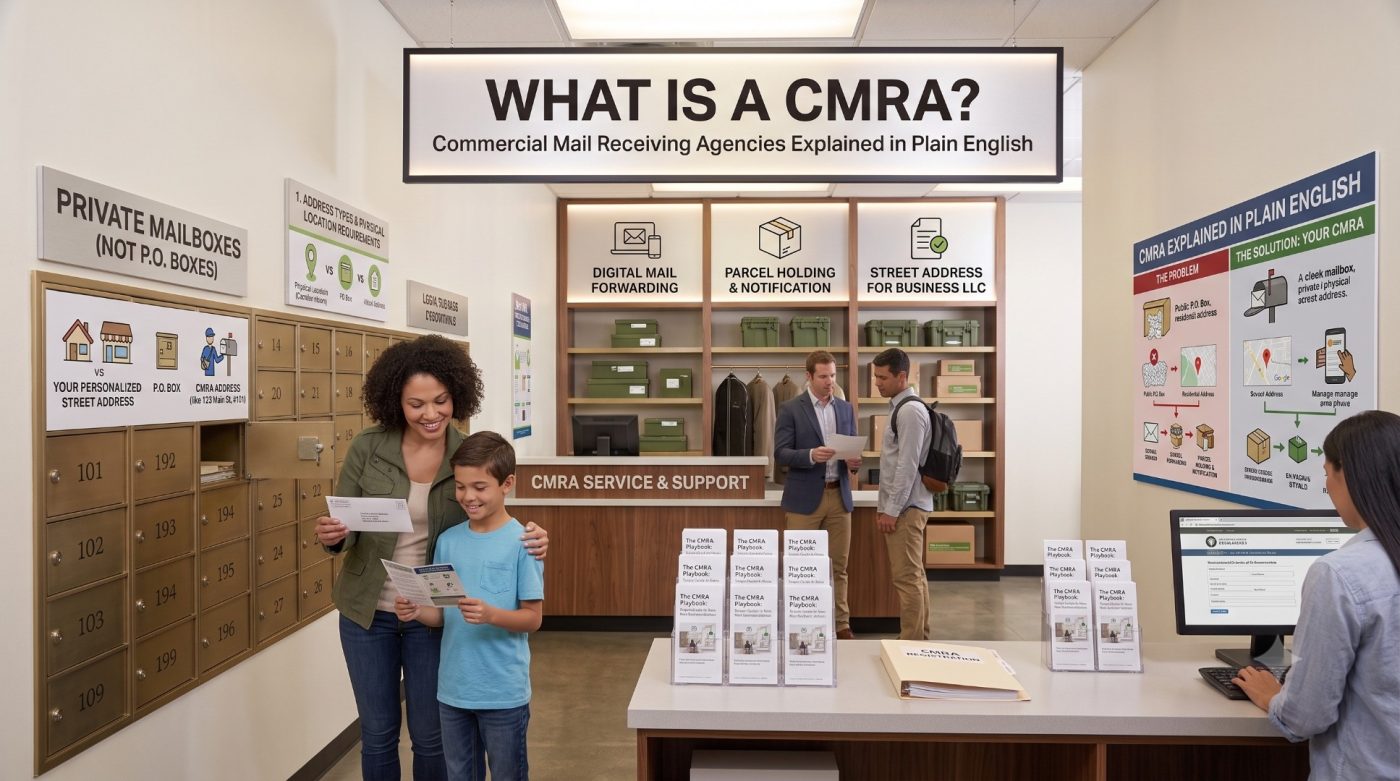
A CMRA (Commercial Mail Receiving Agency) is a private business authorized by the United States Postal Service to receive mail on behalf of its customers. Every legitimate private mailbox store, virtual mailbox company, and mail forwarding service in the US operates as a registered CMRA under USPS oversight. This guide explains what the designation means, how a CMRA address differs from a PO Box and a home address, what the registration rules require, and how to check whether a provider is operating legally.
Table of Contents
- What CMRA Means
- How a CMRA Works Behind the Counter
- The Three US Address Types Compared
- The Rules Every CMRA Must Follow
- The PMB Question: How Your Address Is Written
- Do Banks and Agencies Accept CMRA Addresses?
- 4 CMRA Myths, Corrected
- How to Verify a Provider Before You Sign Up
- Frequently Asked Questions
What CMRA Means
Commercial Mail Receiving Agency is the Postal Service’s formal name for a private business that accepts mail for third parties. The corner UPS Store, a virtual mailbox startup, and a family-run business center like ours all hold the same designation.
The designation is not a rubber stamp. A CMRA registers with the local postmaster, keeps a completed USPS Form 1583 on file for every single customer, verifies two forms of ID per person, and submits to USPS inspection of those records. The system exists to stop mail fraud: before CMRAs were regulated, anonymous mail drops were a favorite tool for scams.
MyMailForwarder.com is operated by Neighborhood Parcel, a federally authorized CMRA in Massachusetts, in continuous operation since 2007. We treat the designation as the backbone of the service, because it is.
How a CMRA Works Behind the Counter
Here is what actually happens to a letter addressed to you at a CMRA.
- The carrier delivers the day’s mail to the facility in bulk.
- Staff sort each item to the correct private mailbox (PMB) number and log it.
- You receive a notification. At our facility, every arrival triggers a free email alert the same day.
- The item waits in secure storage for your instruction: forward, scan, hold, or shred.
- Your instruction is executed and recorded.
Two details separate operators. First, who does the handling: some companies own and staff their building, while software platforms resell mailboxes at thousands of third-party locations they have never visited. Second, what the storage looks like: a monitored, limited-access mail room is not the same as a shelf behind a retail counter. Our guide to choosing a mail forwarder gives you the full checklist.
The Three US Address Types Compared
| Feature | CMRA street address | USPS PO Box | Home address |
|---|---|---|---|
| Real street address format | Yes | No | Yes |
| Accepts FedEx, UPS, DHL, Amazon | Yes | No | Yes |
| Works while you live abroad | Yes, remotely managed | No, requires pickup | Only if someone lives there |
| Keeps your location private | Yes | Yes | No |
| Staffed receiving with signature | Yes | No | Only if you are home |
| Scanning, forwarding, storage services | Yes | No | No |
| ID verification required | Yes, Form 1583 | Yes, PS Form 1093 | None |
The PO Box comparison deserves its own article, and it has one: our breakdown of a virtual mailbox vs. a PO Box. The short version: a PO Box is fine for local, USPS-only letter mail you collect yourself. It cannot receive private-carrier packages, and it does not function at all from another country.
The Rules Every CMRA Must Follow
The regulatory framework lives in the USPS Domestic Mail Manual. Four requirements matter to you as a customer.
Registration. The agency registers with USPS and appears in the postal system as a CMRA location. This is public infrastructure, not a private arrangement.
Identity verification. Two forms of ID per customer, one with a photo, documented on Form 1583 before any mail is handled. An agency that activates your box without this paperwork is breaking federal rules with your mail in its hands.
Recordkeeping. The signed 1583 stays on file and available for postal inspection for as long as you are a customer, plus a retention period afterward.
Mail handling standards. A CMRA may only deliver mail to the addressee or forward it on the addressee’s instruction. It re-mails items with new postage when forwarding. It cannot simply drop your mail back into the USPS stream unpaid.
These rules are why the setup process involves paperwork, and why that paperwork is a good sign rather than a hassle. The provider asking for your notarized form is the provider following the law.
The PMB Question: How Your Address Is Written
USPS regulations require CMRA customer addresses to include a private mailbox designator, written either as PMB or as a pound sign. A properly formatted CMRA address looks like a normal commercial street address with a suite or PMB number:
Your Name
1215 Main St, Unit 115 PMB 123
Tewksbury, MA 01876
Senders treat it like any other street address. FedEx, UPS, and Amazon deliver to it without question, because it is a physical building with staff who sign for packages. Retail checkout pages accept it, because it validates as a deliverable street address in every address database.
Do Banks and Agencies Accept CMRA Addresses?
This is the question behind most searches about CMRAs, so here is the careful answer.
As a mailing address: broadly yes. Banks, the IRS, brokerages, insurers, and state agencies accept a CMRA street address as the place you receive mail. The IRS corresponds with millions of taxpayers at commercial addresses. Massachusetts accepts our address on corporation and LLC filings, and we layer registered agent service on top for businesses that need it.
As a residential address: no, and do not present it as one. Some forms ask specifically for your physical residence, including certain bank onboarding flows, driver’s license applications, and voter registration. Address databases flag CMRA locations as commercial, so writing one in a residence field can trigger follow-up questions. The honest setup works better: your CMRA address as your mailing address, your actual residence where residence is required. Requirements vary by institution and by state, so verify your specific use case with the institution itself.
For expats, this two-address setup is standard practice and it works. Our guide on keeping your US bank account while living abroad covers the banking side in depth.
4 CMRA Myths, Corrected
Myth 1: a CMRA address is a PO Box. No. A PO Box is a numbered compartment inside a post office with a PO Box address format. A CMRA is a staffed commercial building with a street address. Carriers, banks, and checkout pages treat the two completely differently.
Myth 2: CMRA addresses are red flags. A CMRA designation means the location passed USPS registration and follows federal ID rules. What creates problems is misrepresenting any commercial address as your home. Used honestly, a CMRA address is the most compliant way to receive mail you do not want sent to your house.
Myth 3: all CMRAs are the same. The designation sets a floor, not a ceiling. Staffing, storage security, scanning turnaround, carrier rates, and consolidation policies vary enormously. Two CMRAs can hold identical registrations and deliver completely different service.
Myth 4: you can skip the paperwork with the right provider. Any provider skipping Form 1583 is violating the rules that make the whole system trustworthy. Twenty minutes of paperwork is the price of a federally supervised chain of custody for your mail.
How to Verify a Provider Before You Sign Up
- Ask for the facility address and look at it on a map. A real operator shows you a real building. Street View shows you whether it is an office or a mail drop.
- Ask who handles the mail. Own employees in their own building, or a reseller network of third-party stores?
- Ask for the Form 1583 process upfront. A compliant provider explains it before taking your money.
- Check tenure and ratings. Years in operation and a Better Business Bureau record tell you more than a landing page. We have operated since 2007 with a BBB A rating.
- Read the fee schedule. Storage windows, scanning rates, consolidation charges, and forwarding markups are where cheap providers earn their money back. Our virtual mailbox cost guide lists the eight hidden fees to check.
Why CMRAs Are Regulated: A Short History
Private mail drops are older than the regulations covering them, and the regulations exist because of what happened without them. Through the 1980s and 1990s, anonymous mail drops became standard tooling for mail-order fraud: fake sweepstakes, phantom merchandise sellers, and identity schemes all ran through rented boxes with no verified names behind them. Postal inspectors could seize mail but often could not identify renters.
The Postal Service responded with the modern CMRA framework: mandatory registration of agencies, mandatory identity verification of every customer through Form 1583 with two IDs, mandatory recordkeeping open to postal inspection, and addressing standards that let systems distinguish commercial receiving points from residences. The reforms around 1999 drew loud complaints about privacy and paperwork at the time. Two decades later they are why a bank, a court, and a customs officer all treat a properly registered CMRA address as accountable infrastructure. The paperwork is the trust.
Knowing the history also explains the occasional friction. When an institution hesitates at a commercial address, it is applying a lesson learned from the pre-regulation era to a post-regulation world. The answer is never to disguise the address type. It is to use a well-run CMRA, present the address honestly as your mailing address, and let the verification chain speak for itself.
Address Formatting: Small Details That Prevent Big Problems
USPS addressing standards give CMRA customers a specific format, and following it precisely keeps mail machine-sortable and institution-friendly.
Use the PMB or # designator on its proper line. The compliant formats place your box number with the street address: 1215 Main St, Unit 115 PMB 123, or 1215 Main St #123. Do not relabel it as Suite or Apt to look residential; address-validation databases know the location type, and the mismatch between claimed unit type and known commercial location is itself a flag.
Never drop the box number. Mail addressed to the bare street address without your PMB arrives at a facility with hundreds of boxes and no way to route it. Facilities handle this gracefully when the name matches a customer, but every dropped number adds a manual step and a delay.
Keep the name field matching your Form 1583. The facility can only release mail to names on file. Your side hustle’s brand name on a package label works when that name is declared, and stalls when it is not; the Form 1583 guide covers declaring multiple names and businesses.
Standardize everywhere. Pick the exact format once, save it in your browser’s autofill and your password manager, and reuse it character for character. Half of all address friction is self-inflicted inconsistency across accounts.
CMRA vs. Virtual Office vs. Coworking Address
Three commercial-address products get confused constantly, and they solve different problems.
A CMRA mailbox is built for mail custody: receiving, logging, scanning, forwarding, storage, under postal regulation. It is the right tool for mail volume, package handling, and any use where the chain of custody matters.
A virtual office sells business presence: a prestigious address for marketing, phone answering, and meeting rooms by the hour. Mail handling is usually a thin add-on, sometimes an afterthought handled by front-desk staff between tours. Fine for impressing clients; weak for forty envelopes a month.
A coworking address ties your mail to your membership at a shared workspace. When the membership ends, or the location closes, the address dies with it, and coworking front desks are not postal operations. Convenient while you work there daily; risky as your address of record.
The pattern for choosing: put your address of record where mail is the core business, and buy presence or desks separately if you need them. Businesses that need the legal-notice role covered add a registered agent service, which is a distinct legal function, not an address product.
What Happens If a CMRA Closes?
A fair question to ask any provider before signing up, and one the industry rarely discusses. When a CMRA shuts down, USPS procedures require notice, and mail addressed there is handled through the closure process rather than silently discarded. Practically, though, a closure still means updating every sender on a deadline you did not choose.
You reduce the risk the same way you evaluate any vendor: prefer operators with long tenure, real premises, and a business beyond the mailbox counter. A facility that has operated since 2007, owns its operation, and serves walk-in shipping and business customers daily has a fundamentally different risk profile from an address reseller renting desk space month to month. Longevity is not glamorous, and it is exactly what you are buying in an address of record.
Keep your own hedge, too: maintain a current export of your sender list (the audit habit from our forwarding comparison guide), so that any forced address change, however unlikely, is an afternoon of updates instead of an archaeology project.
A Day Inside a Working CMRA
Abstractions aside, here is what the designation looks like on an ordinary Tuesday at our Tewksbury facility, because the daily routine is the service.
9:40 am. The USPS truck arrives with trays of letter mail and parcels. Two staff members sort against the PMB roster, and every item is logged to an account. A misaddressed envelope with no matching name goes to the exceptions shelf for research rather than into a customer’s box.
10:15 am. Arrival notifications go out. In Dubai, a subscriber sees a bank envelope on her phone and taps scan. In Lisbon, another sees three retail boxes land and replies consolidate and hold; two more are coming Thursday.
11:00 am. The scanning queue runs. Envelopes are opened on request only, contents scanned to searchable PDF, originals filed back into the customer’s storage bin. The Dubai subscriber reads her letter over lunch, eight time zones away, four hours after it left the truck.
1:30 pm. FedEx and UPS drop afternoon parcels, including a laptop a retailer refused to ship overseas. Staff sign, log, and photograph condition. The buyer in Doha gets his alert and schedules forwarding for Friday’s consolidated box.
3:00 pm. Outbound: consolidated boxes are packed, customs declarations completed from customer-confirmed contents, and shipments tendered to USPS, FedEx, and UPS at discounted rates. A registered-agent envelope from a Massachusetts court, received this morning for an LLC client, has already been scanned and emailed with a same-day alert.
4:45 pm. Shred bin items, authorized by their owners from their phones, are destroyed. The exceptions shelf is worked: one envelope matched a customer’s newly added business name and released; one goes back to USPS as undeliverable.
Multiply that Tuesday by nearly two decades and you have the difference between an address product and a mail operation. When you evaluate providers, ask them to describe their Tuesday. The ones with a real answer are the ones you want holding your name on a Form 1583.
Who Actually Uses CMRA Addresses
The customer base is broader than most people expect, and seeing the range clarifies whether you belong in it. American expats anchor US banking and IRS mail to a monitored address; our subscribers span 220+ countries. Digital nomads run their entire postal life through one address that survives every border crossing, as covered in the nomad mail guide. Home-based business owners keep apartments off public filings. International shoppers give US retailers a domestic address, then consolidate purchases into cheap outbound shipments. Snowbirds route two seasonal homes through one permanent address. Deployed service members shop retailers that refuse APO checkout, then forward by USPS to the military system. Landlords, executors, privacy-conscious professionals, and people leaving shared households round out the list. The common thread: everyone whose life outgrew the assumption of one person, one house, one mailbox.
What CMRA Service Costs, Briefly
Industry-wide, CMRA mailbox plans run from roughly $10 to $120 per month depending on volume, scanning, and storage, with hidden per-action fees deciding the real bill at many providers. Our plans run $330 to $595 per year with one bonus month on annual billing, free consolidation on Silver and Gold, and storage from 30 to 90 days by plan. The complete fee-by-fee breakdown, including the eight charges providers bury in fine print, lives in our virtual mailbox cost guide.
Frequently Asked Questions
What does CMRA stand for?
Commercial Mail Receiving Agency. It is the USPS designation for a private business authorized to receive mail on behalf of customers, under federal identity-verification and recordkeeping rules.
Is a CMRA address a real street address?
Yes. A CMRA operates at a physical commercial building, and your address there is written in standard street-address format with a suite or PMB number. All carriers deliver to it.
What is the difference between a CMRA and a PO Box?
A PO Box is a compartment inside a post office, accepts USPS mail only, and requires in-person pickup. A CMRA is a staffed business with a street address that accepts every carrier and offers forwarding, scanning, and storage services.
Can I use a CMRA address for my LLC?
Generally yes, as the business mailing address, and in Massachusetts our address satisfies the street-address requirement on state filings. Registered agent requirements are separate; we provide Massachusetts registered agent service for that role. Requirements vary by state, so confirm your state’s rules.
Do banks accept CMRA addresses?
Banks broadly accept CMRA addresses as mailing addresses. Some ask separately for a residential address during onboarding. Provide both honestly: the CMRA address for mail, your residence where residence is required. Policies vary by institution.
How do I know if a mailbox provider is a registered CMRA?
Ask them directly, and expect a confident answer with a facility address. A registered CMRA will also require USPS Form 1583 with two IDs before activating your mailbox. A provider that skips the form is the red flag.
A USPS-Approved CMRA With a Name on the Door
Your mail deserves a registered agency, a staffed building, and people accountable for every envelope. That is what a CMRA designation promises, and what we have delivered from the same Massachusetts address since 2007.
See mailbox plans and pricing or read how to apply for your mailbox address.
Related Guides
- What to do when a bank rejects a virtual mailbox address
- Virtual mailbox vs PO Box
- How to get a US address
- Business mailing address for a home-based business
- Is a virtual mailbox worth it?
