
Mail Forwarding Service
Prohibited Items for Mail Forwarding: A to Z Lookup of What You Can and Can’t Ship
Mar
Key takeaways
- Three sets of rules apply to every forwarded parcel: the carrier’s safety rules, US export law, and your destination country’s import list. An item has to pass all three.
- USPS won’t carry perfume containing alcohol, or loose lithium batteries, to any international address. Private couriers accept some of these only as regulated dangerous goods.
- Electronics ship fine with the battery installed. Power banks, spare batteries and e-bike batteries usually don’t.
- Many “surprises” are legal in the US but banned where you live: melatonin in the UK, pseudoephedrine in Japan, chewing gum in Singapore, vapes in Mexico.
- If a prohibited item reaches us, we hold it out of your shipment and help you return it. We never hide it in a box and hope.
What’s in this guide
- Why forwarders restrict items: the three layers
- The A to Z lookup table
- The hard no’s, grouped and explained
- The “ask first” items
- Perfume, batteries and alcohol by carrier
- Lithium batteries, made simple
- Country surprises that get parcels seized
- Destinations we can’t ship to
- Everyday products that catch people out
- What happens if a banned item reaches us
- The 60-second check before you buy
- FAQs
Why mail forwarders restrict what they ship: the three layers
People sometimes assume a forwarder’s list is just the company being cautious. It isn’t. Every international parcel has to clear three separate rulebooks, and a forwarder that ignores any of them loses its carrier accounts. That would hurt every customer, not just the one with the aerosol can.
USPS, DHL, FedEx and UPS move parcels by air. Flammable liquids, pressurized cans and loose lithium cells have caused real cargo fires, so aviation dangerous-goods rules leave no wiggle room.
A parcel leaving the US is an export. Federal rules control weapons, weapon parts, some optics and electronics, and who may receive shipments. Violations can be criminal.
Your customs agency has its own banned and restricted list, often stricter and stranger than the US one. Legal to export doesn’t mean legal to import.
An item is only safe to forward when it passes all three. That’s why the same bottle of vitamins can be fine for Germany and seized in Australia, and why a hunting knife from a US sporting goods store can arrive in one country and be confiscated in another. For how the rest of the forwarding process works, see how mail forwarding works.
The A to Z lookup: can I forward this?
Type an item into the search box to filter the list. Yes means it normally ships to most countries. Ask first means it depends on quantity, carrier or destination. No means we can’t forward it. Your destination can still ban a “yes” item, so check the country section too.
| Item | Verdict | Why, and what to do |
|---|---|---|
| Aerosol cans (any: hair spray, spray paint, spray deodorant) | No | Pressurized, so banned from air transport whatever is inside. Buy the stick, gel or pump version. |
| Airbags and seatbelt pretensioners | No | They contain explosive charges. Other car parts are usually fine. |
| Airsoft and paintball guns | No | Treated as weapon replicas by customs in much of the world. |
| Alcohol: beer and spirits | Ask first | USPS won’t mail alcohol. Courier options are narrow and destination-dependent. |
| Alcohol: table wine | Ask first | Limited quantities to some countries by courier. Never to countries that ban alcohol, such as Saudi Arabia. |
| Ammunition, magazines and clips | No | Explosive and export-controlled. |
| Batteries: alkaline AA and AAA | Yes | Not lithium, so not treated as dangerous goods. Keep them in retail packaging. |
| Batteries: loose lithium, spares, camera batteries | No | Loose lithium cells are the strictest air category. Buy the device with the battery installed. |
| Body armor and tactical gear | No | Military and police gear is export-controlled. |
| Books, documents and printed matter | Yes | Cheapest and easiest thing to forward. |
| Candles (solid wax) | Yes | Fine. Pack for heat in summer. |
| Cash, money orders, cashier’s checks, bearer bonds | No | No carrier insures them. For checks mailed to you, we scan them so you can use mobile deposit. |
| CBD, hemp and cannabis products | No | Illegal to import in many countries, including Canada, even where they’re legal locally. |
| Chewing gum | Ask first | Fine almost everywhere, but Singapore bans importing it. |
| Chocolate, candy and packaged snacks | Yes | Shelf-stable and sealed is fine for most countries. Avoid anything with meat. Australia and New Zealand check all food. |
| Clothing, shoes and bags | Yes | Our most common category. Counterfeits are the exception. |
| Coffee and tea (sealed) | Yes | Usually fine. Some countries inspect or limit quantities. |
| Contact lenses | Ask first | Some countries regulate them as medical devices. |
| Cosmetics: creams, lipstick, makeup | Yes | Fine. Watch for nail polish, aerosols and alcohol-based sprays in the same order. |
| Counterfeit or replica designer goods | No | Seized at nearly every border, and forwarding them is illegal. |
| Crossbows, swords and martial arts weapons | No | Weapons, whatever the local rules. |
| Deodorant (stick or gel) | Yes | The spray version isn’t allowed. |
| Drones | Ask first | Fine with the battery installed. Spare batteries aren’t. Some countries require drone registration or ban certain models. |
| Dry ice | No | Regulated dangerous good. |
| E-bikes, e-scooters and hoverboards | No | Batteries far above 100 Wh are fully regulated dangerous goods. |
| Electronics: laptops, phones, tablets, cameras, headphones | Yes | With the battery installed. See the battery section. |
| Essential oils | Ask first | Many are flammable. Small retail bottles sometimes qualify, so send us the product. |
| Fireworks, sparklers and party poppers | No | Explosives. |
| Fuel canisters and camping gas | No | Pressurized and flammable. Buy fuel at your destination. |
| Furs, exotic skins, ivory, tortoiseshell | No | Protected by wildlife treaties. Seized at the border. |
| Government ID lookalikes, badges and uniforms | No | Anything designed to look official. Ask us about secure handling if a real document of yours arrives from a US agency. |
| Gun parts, rails, grips and holsters | Ask first | Rails, grips and other parts are export-controlled, so the answer is almost always no. Plain leather holsters and cleaning cloths sometimes pass. |
| Guns, including replicas and toy guns that look real | No | Firearms and realistic replicas are both banned. |
| Hair spray and dry shampoo | No | Aerosols. Powder dry shampoo is fine. |
| Hand sanitizer | No | High alcohol content makes it a flammable liquid. |
| Handcuffs and restraints | No | Police equipment. |
| Honey | Ask first | Banned or restricted in Australia, New Zealand and some other countries. |
| Jewelry, watches and precious stones | Ask first | Ships to many countries, but our insurance tops out at $500. Pricier pieces travel at your own risk. |
| Knives: kitchen, hunting and pocket | Ask first | Legal in the US, restricted elsewhere. Canada bans switchblades and butterfly knives, and the UK bans flick and butterfly knives. |
| Laser sights, rifle scopes and night vision | No | Export-controlled optics. |
| Lighters and lighter fluid | No | Flammable. |
| Live plants, seeds and soil | No | Agricultural biosecurity rules everywhere. |
| Lock picks | No | Banned by several postal systems. |
| Lottery tickets and gambling devices | No | Prohibited in international mail. |
| Matches | No | Flammable. |
| Meat, jerky and dairy | No | Animal products are policed hard by agriculture inspectors. |
| Melatonin | Ask first | A supplement in the US, but prescription-only in the UK and tightly limited in Australia. |
| Mercury thermometers and barometers | No | Hazardous material. |
| Motor oil, paint thinner and solvents | No | Flammable or hazardous. |
| Nail polish and nail polish remover | No | Flammable liquids, even one bottle. |
| Paint: oil-based or spray | No | Flammable or pressurized. Water-based craft paint: ask first. |
| Pepper spray and stun guns | No | Aerosol and weapon at once. Prohibited weapons in Canada and many other countries. |
| Perfume, cologne and body mist | Ask first | Alcohol-based, so classed as a flammable liquid. USPS won’t take it internationally. See carrier options. |
| Perishable food | No | Anything needing refrigeration will spoil in transit or customs. |
| Pet food and treats | Ask first | Often counted as an animal product. Many countries restrict it. |
| Power banks and portable chargers | No | A power bank is a loose lithium battery. USPS refuses them internationally, and most courier lanes do too. |
| Prescription medication (human or veterinary) | No | Seized almost everywhere without import permits. |
| Pseudoephedrine cold medicine (Sudafed-type) | No | Banned in Japan and restricted in many countries. Treat any US cold medicine as ask-first at the very least. |
| Over-the-counter medicine (pain relievers, allergy) | Ask first | Often allowed in personal quantities, but some ingredients are controlled abroad (codeine, pseudoephedrine, some sleep aids). |
| Smartwatches and fitness trackers | Yes | Small installed batteries are fine. |
| Sunscreen (lotion) | Yes | Spray sunscreen is an aerosol and isn’t allowed. |
| Supplements, vitamins and protein powder | Ask first | Easy to export, but many countries cap quantities or ban ingredients. Check yours. |
| Tobacco and cigarettes | No | Federal law bars mailing cigarettes, and we don’t forward tobacco. |
| Toys (non-weapon) | Yes | Fine. Toys with lithium batteries follow the battery rules. |
| Vapes, e-cigarettes and e-liquids | No | USPS has been barred from mailing them since 2021, and the major couriers don’t carry them to consumers. Several countries, including Mexico, ban importing them. |
| Wet-cell batteries and car batteries | No | Corrosive dangerous goods. |
The hard no’s, grouped and explained
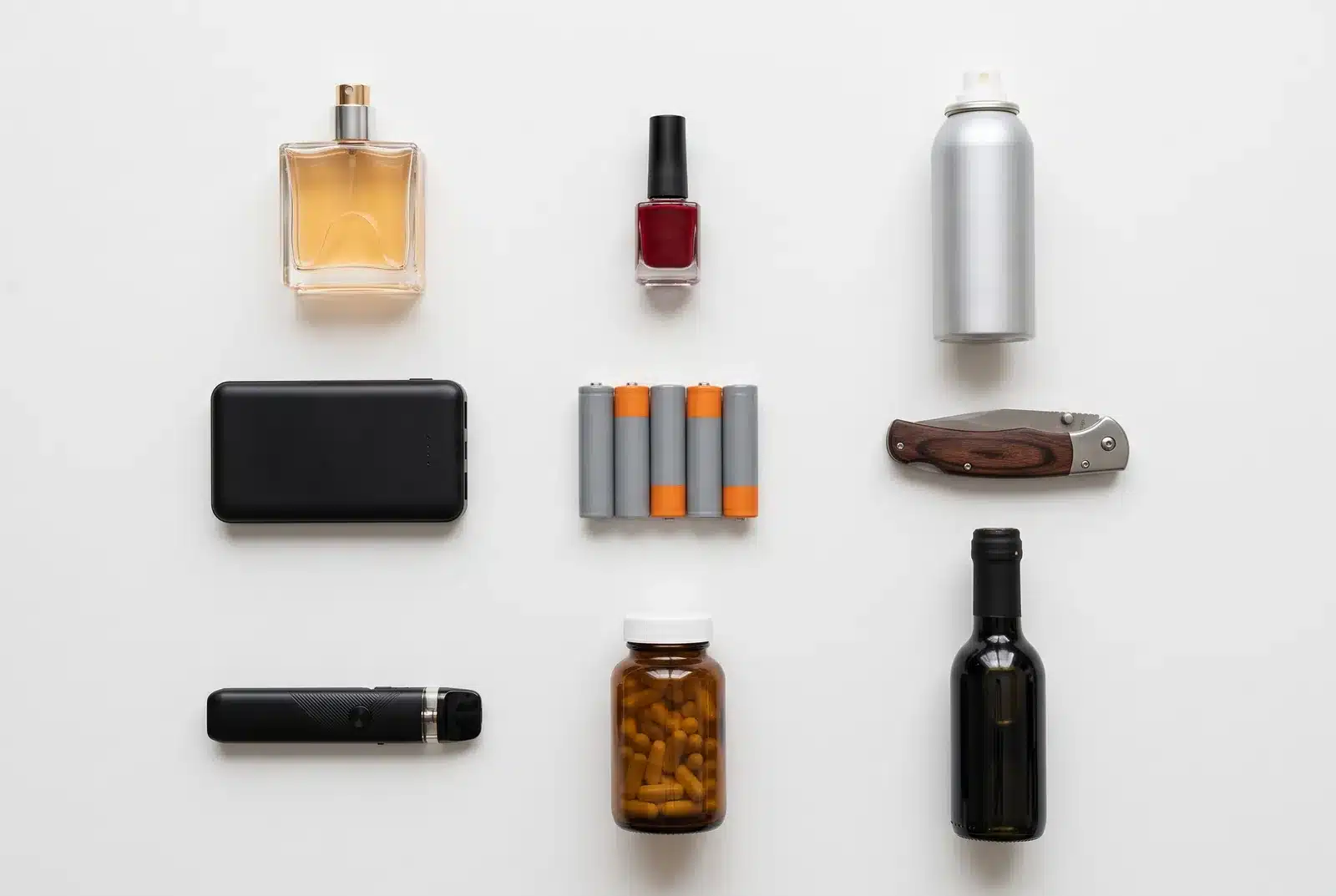
You don’t need to memorize a list. Almost everything banned belongs to one of seven families, and once you know them you can predict the answer for products that aren’t in the table.
Nail polish, lighter fluid, oil paint, solvents, hand sanitizer, fuel. If the label shows a flame, it won’t fly.
Every aerosol, from spray sunscreen to whipped cream, plus gas canisters. The can is the problem, not what’s inside it.
Fireworks, ammunition, airbags, matches, dry ice, mercury, chemicals, anything with a hazmat diamond.
Guns, replicas, parts, scopes, stun guns, pepper spray, swords, crossbows, tactical gear. Export law covers parts and accessories too.
Plants, seeds, soil, meat, dairy, furs, protected animal products. Biosecurity officers everywhere are strict.
Prescription medicine, CBD, tobacco, vapes. Rules change at every border, and seizure is the norm.
Cash, bearer instruments, lottery tickets, fake ID, badges and uniforms. They attract theft and fraud, and no carrier will insure them.
Don’t ask “does this seem dangerous?” Ask how an airline’s dangerous-goods table and a customs officer would classify it. That’s what decides it.
The “ask first” items, one by one
These are the items we get asked about every week. None is a flat yes or a flat no, so here’s what the answer depends on.
Perfume and cologne
Fragrance is mostly alcohol, which makes it a flammable liquid to every airline. USPS doesn’t accept perfume containing alcohol for any international address, including military APO and FPO mail. Private couriers carry it only as a regulated “limited quantity” dangerous good, under special terms, and not on every route. So the answer depends on where you live and which lanes are open to that country. Send us the exact product and your destination before you order, especially around the holidays, when gift sets with a hidden bottle of perfume cause the most disappointment.
Alcohol
USPS won’t mail alcoholic drinks at all. Where we have a courier lane, table wine can go in limited quantities to some countries, with import duty due on arrival. Spirits and beer face tighter rules. Countries that ban alcohol imports, such as Saudi Arabia, are a firm no. Our guide to mail forwarding to Saudi Arabia covers that market’s other restrictions.
Jewelry, watches and precious stones
Many countries accept them, but some restrict them, and our shipping insurance is capped at $500. Above that you’d be shipping at your own risk, which rarely makes sense for a valuable piece. Plan high-value shipments with us first, or consider carrying them in person.
Supplements, vitamins and over-the-counter medicine
This is where “legal in the US” misleads people most. Leaving the US is rarely a problem. Getting in at the other end often is. Melatonin is prescription-only in the UK. Japan bans cold medicine containing pseudoephedrine. The UAE requires approval for medicines with codeine. Many countries cap the number of bottles you can import for personal use. Check your country’s customs site, then send us the ingredient list if you’re unsure.
Knives
A chef’s knife or a hunting knife is an ordinary purchase in the US. Abroad, blade length, locking mechanisms and opening style decide whether it’s a tool or a prohibited weapon. Canada bans automatic (switchblade) and butterfly knives. The UK bans flick and butterfly knives. Tell us the exact model and we’ll check it against your destination.
Drones and camera gear
The drone itself usually ships with its battery installed. Extra batteries are the problem. Some countries also require registration or restrict certain models, and high-end thermal or night-vision cameras can be export-controlled. We had a photographer order six spare drone batteries and no drone. That’s the strictest battery case there is, and none of our routes could take it. She switched to a bundle with one battery installed, and it shipped without trouble.
Food
Sealed, shelf-stable, commercially packaged food (snacks, candy, coffee, spices) ships to most countries. Anything with meat or dairy, anything fresh, and honey to Australia or New Zealand is a problem. Both of those countries expect every food item to be declared. The Australia forwarding guide has the details.
Not sure about a product? Send the link and your country before you check out. A “no” costs nothing before the purchase and a return fee after it.
Ask before you buyPerfume, batteries and alcohol, carrier by carrier
People often search “can I ship perfume internationally with USPS” or “with DHL,” and the answers really do differ. Here’s the simplified picture for outbound international shipments. Private couriers accept regulated items only under special dangerous-goods terms, so availability through any forwarder depends on the route and the account.
| Item | USPS international | DHL / FedEx / UPS |
|---|---|---|
| Perfume and cologne | Not accepted | Limited quantities, special terms only |
| Phone, laptop or camera, battery installed | Yes, within limits | Yes, with required marks |
| Spare lithium batteries, power banks | Not accepted | Rarely, fully regulated |
| Alcoholic drinks | Not accepted | Licensed or contract shippers, limited countries |
| Aerosols | Not accepted | Not for consumer shipments |
| Nail polish | Not accepted | Limited quantities, special terms only |
| Vapes and e-cigarettes | Barred by federal law | Not carried for consumers |
This is one reason we compare carriers for every shipment instead of defaulting to one. Picking the right lane for what’s in the box is part of the international shipping savings we pass on, and it’s why honest content descriptions matter so much.
Lithium batteries, made simple
About half of what people buy online now has a lithium battery in it, so this section matters more than any other. The rules follow one idea: a battery inside the device it powers is low-risk, and a loose battery is high-risk.
Phone, laptop, tablet, camera, e-reader, smartwatch.
Usually shipsA camera with a spare battery in the same box.
Carrier-dependentSpare batteries, power banks, battery packs, 18650 cells.
Usually refusedUSPS specifics: for international mail, USPS accepts lithium batteries only when they’re installed in the equipment they operate, with no more than four cells or two batteries in the package. Each lithium-ion battery must be 100 watt-hours or less. Loose batteries and power banks aren’t accepted to any foreign address.
How to find the watt-hours: look for “Wh” printed on the battery. If it only shows volts and milliamp-hours, multiply them: volts × mAh ÷ 1,000 = Wh. A 3.7 V, 5,000 mAh phone battery is 18.5 Wh. A typical laptop battery is 40 to 99 Wh. E-bike and scooter batteries are usually 300 to 700 Wh, which puts them in fully regulated territory. We don’t forward those.
Damaged, swollen or recalled batteries can’t ship on any carrier. If a device arrives with a swollen battery, we’ll let you know and hold it rather than put it on a plane.
Country surprises that get parcels seized
Getting a parcel out of the US is half the job. Your country’s customs agency decides the rest, and its list is often stricter. These are the destination rules that surprise our customers most. Rules change, so confirm on your customs agency’s website before buying anything borderline.
Very strict biosecurity. Seeds, soil, wood, honey and most animal products are refused, and all food must be declared. Melatonin is tightly limited.
Just as strict on food, plant material and anything that has touched soil, including used hiking boots and camping gear.
Melatonin is prescription-only. Flick knives and butterfly knives are banned. Some supplements are treated as medicines.
Pepper spray, switchblades and butterfly knives are prohibited weapons. Cannabis and CBD can’t be imported, even though they’re legal to buy in Canada. See our US to Canada forwarding guide.
Cold and allergy medicines with pseudoephedrine are banned, as are stimulant medications. Many other medicines need advance import approval.
Chewing gum can’t be imported, apart from approved dental and nicotine gum. E-cigarettes are banned.
Poppy seeds are prohibited. Some medicines, including those with codeine, need prior approval. Our UAE and Middle East guide has more.
Importing vapes and e-cigarettes is banned. Duty applies above a low threshold. See mailboxes for American expats in Mexico.
Import taxes are a separate question from bans, and just as important for your budget. Our customs duties guide explains the duty-free thresholds that decide whether a parcel arrives with a bill. If you’re comparing destinations, start with shopping in the USA and shipping internationally.
Destinations we can’t ship to
We forward to more than 220 countries. A short list sits outside every route we run. We don’t ship to Cuba, Iran, North Korea, Syria, Sudan, Burma (Myanmar) or Israel, along with other destinations we classify as high-risk as conditions change. Some of these reflect US sanctions law, where shipping would be a federal offense. Others reflect carrier availability and conditions on the ground.
We also screen every shipment against the US government’s denied-party lists: the Treasury’s sanctions list and the Commerce Department’s restricted-party lists. It’s invisible in the normal case and takes seconds. It’s also why we ask for accurate recipient names. If you move to a country we serve, your mailbox keeps working with no changes. That’s one of the quiet advantages of a US mailbox that stays put in Massachusetts while you move.
Everyday products that catch people out
Nobody expects dynamite to fly. These are the ordinary items that catch reasonable people every month, usually hidden inside a bigger order:
- Nail polish inside a makeup haul. One bottle can hold up a whole consolidated box.
- Spray sunscreen and dry shampoo in a beauty order. Aerosols, whatever the ingredients.
- Hand sanitizer in a back-to-school bundle. Flammable liquid.
- A “free power bank” thrown in with a phone case. A loose lithium battery.
- Perfume gift sets at the holidays. The sweater and candle ship. The fragrance doesn’t.
- Camping kits with fuel canisters, a lighter and a fixed-blade knife. Two of those three can’t fly.
- Beef jerky in a snack box. Meat is an animal product.
- Cold medicine in a family care package headed to Japan.
A related trap is retailer substitution. When an item is out of stock, some US stores swap in something “equivalent,” and the swap can cross a line: a pump bottle becomes an aerosol, or a device becomes a device plus a spare battery. Check your order confirmation against what you picked. If a substitute sounds like one of the categories above, tell us it’s coming.
What happens if a prohibited item reaches our facility
It happens, almost always innocently. Here’s exactly what we do.
- Intake. Every package is logged to your account with sender, carrier, weight, photo and condition. Obvious flags, like an aerosol symbol on the retail box or a hazmat label, show up here.
- Hold and notify. A flagged item is set aside. It isn’t shelved with your outbound stock. You get a note in your dashboard and an email explaining why.
- Inspection at consolidation. When we open retail boxes to repack them, which is free on Silver and Gold plans, the contents are checked again. This catches the nail polish inside a makeup set.
- Your options. Usually a return to the merchant for a refund, or holding the item for pickup by someone in the US. Everything else in your shipment goes out on time.
- Honest declaration. Your customs form lists what’s actually in the box, so the parcel clears without a story attached.
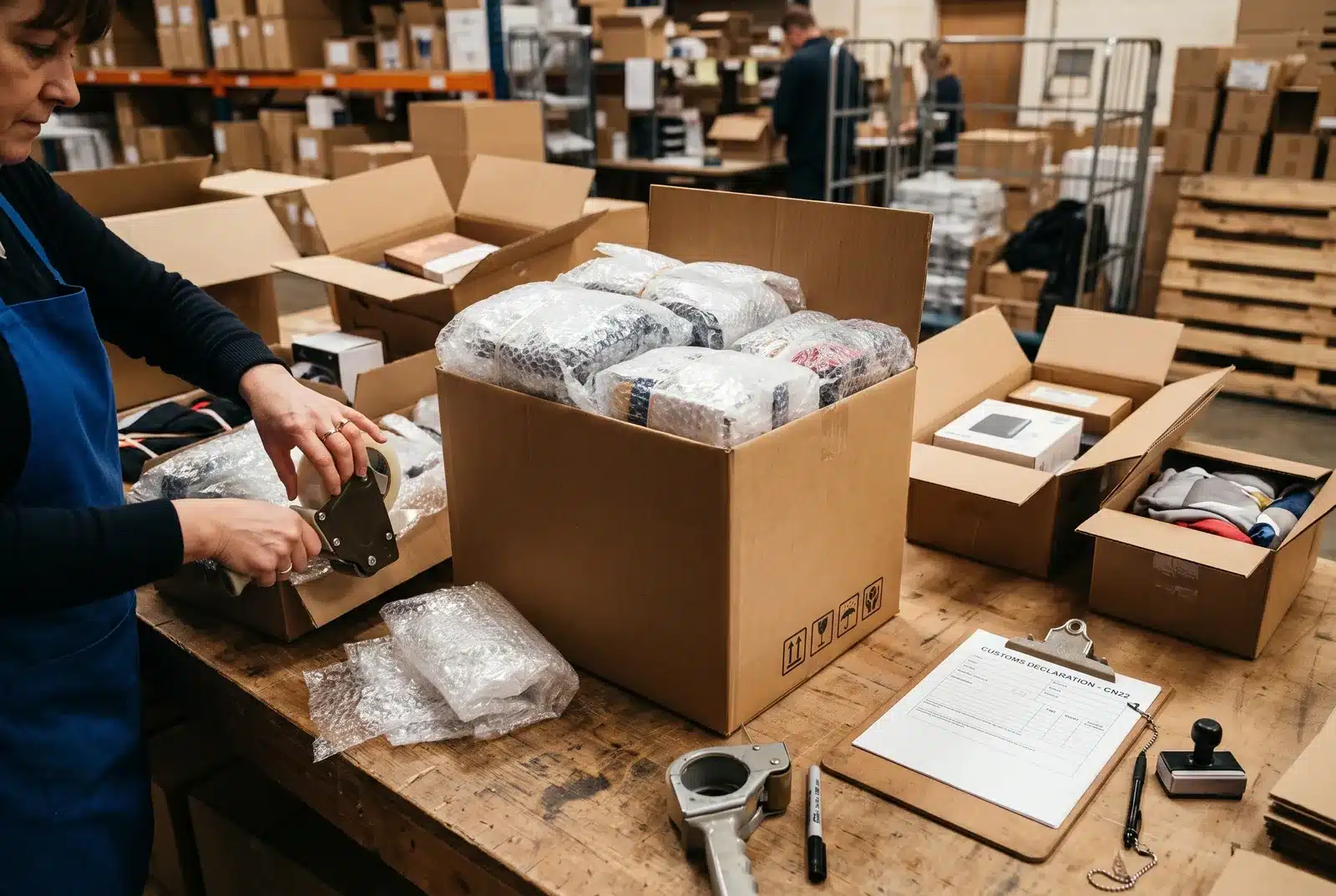
What we won’t do is tuck a banned item into a consolidated box and hope. A discovered violation risks the parcel, a fine, and in serious cases the carrier account every other customer depends on. Consolidation also saves you money: removing bulky retail packaging typically cuts shipping costs by 30 to 40 percent. Our package consolidation service page shows how that works.
Fraud is handled differently from honest mistakes. Stolen cards, reshipping schemes and parcel-mule recruitment lead to account termination and merchandise returned to the merchant. Our guide to reshipping scams and parcel mules explains the warning signs. It’s also why every account is verified with USPS Form 1583 and two IDs at signup.
The 60-second check before you buy
- Name the family. Is it flammable, pressurized, bladed, battery-powered, edible, alive, medicinal or valuable? Most answers are decided right there.
- Look it up above. Search the table. Green is usually fine, yellow means ask, red means don’t buy it for shipping.
- Check your country. Spend two minutes on your customs agency’s prohibited and restricted list, especially for food, supplements and medicine.
- Ask us if it’s yellow. Email the product link and your country, or call (978) 851-0199. We answer these every day.
- Describe it honestly when you request forwarding. Accurate descriptions clear customs faster and keep your account in good standing.
New to forwarding? Start with our application guide and how packages are handled, then keep this page bookmarked for shopping.
Frequently asked questions
What items cannot be forwarded internationally?
Anything flammable, pressurized or explosive (aerosols, nail polish, lighters, fireworks), weapons and weapon parts, ammunition, cash and bearer instruments, prescription drugs, vapes, tobacco, CBD, perishable food, plants, seeds, protected animal products, counterfeit goods, and anything resembling government ID. Perfume, alcohol, jewelry, supplements, knives and lithium batteries depend on carrier and destination.
Can I ship perfume internationally with USPS?
No. USPS doesn’t accept perfume containing alcohol for any international address, including APO and FPO. Private couriers accept limited quantities as regulated dangerous goods on some routes, so ask us with the product and your country.
Can I forward a laptop or phone overseas?
Yes, with the battery installed in the device. USPS allows up to four cells or two batteries installed in equipment per package. Spare batteries and power banks usually can’t go.
Can I forward a power bank?
Usually not. A power bank counts as a loose lithium battery. USPS refuses them internationally, and most courier routes do too. Buy one at your destination.
Can you ship wine or other alcohol?
USPS won’t mail alcohol. We can send table wine in limited quantities to some countries by courier, never to countries that ban alcohol imports such as Saudi Arabia. Ask before you buy.
Can I forward vitamins and supplements?
Usually, but many countries cap quantities or ban specific ingredients. Melatonin is prescription-only in the UK, for example. Check your customs agency’s rules and ask us if you’re unsure.
Can I ship a vape or e-cigarette?
No. USPS has been barred from mailing vaping products since 2021, the major couriers don’t carry them for consumers, and several countries ban importing them.
Which countries do you not ship to?
Cuba, Iran, North Korea, Syria, Sudan, Burma (Myanmar), Israel, and other destinations classified as high-risk under current sanctions and carrier conditions. The list follows world events, so check with us for the current status.
What happens if I accidentally order something prohibited?
We flag it at intake, keep it out of your outbound shipment, and tell you. The usual fix is a return to the merchant for a refund. The rest of your shipment goes out as normal.
Ask before you order. We answer fast.
We’ve screened international shipments from our staffed, USPS-registered Massachusetts facility since 2007, and there’s very little we haven’t been asked to ship. Send the product link and your country through our contact page or call (978) 851-0199, and you’ll have a clear answer before the sale ends.
Ask about an itemSee mailbox plansRelated guides
