
US Mail Forwarding to Canada: A US Address for Canadians
One US Street Address. Everything Forwarded North.
US mail forwarding to Canada works like this: you get a real US street address with your own suite number at our staffed Massachusetts facility, US retailers and senders ship there, and we forward letters and packages to your Canadian address by USPS (handed to Canada Post) or by FedEx, UPS, or DHL. You see every arrival and approve every shipment quote first.

Key Takeaways
- A US address for Canadians is a real street address with a suite number at a USPS-approved Commercial Mail Receiving Agency (CMRA). It is not a P.O. Box, and it accepts USPS, UPS, FedEx, DHL, and Amazon deliveries.
- Forwarding to Canada moves one of two ways: USPS, which hands off to Canada Post at the border, or an express courier (FedEx, UPS, DHL) that clears customs through its own broker.
- Canada charges GST or HST, and in some provinces provincial sales tax, on most imports above a low threshold. Duty depends on where the goods were made. Thresholds differ for postal and courier shipments, so verify current numbers with the CBSA.
- Every separate courier shipment can carry its own brokerage charge. Consolidating several orders into one carton typically cuts the shipping cost 30% to 40% per batch and reduces the number of customs entries to one.
- We are in Tewksbury, Massachusetts, not a border town. This is a forwarding service. If you want to drive across and collect parcels yourself, a border depot suits you better, and we say so below.
- Plans run $330, $450, or $595 per year, with one bonus month on annual billing.
Table of Contents
- How US Mail Forwarding to Canada Works
- Who Uses a US Address From Canada
- Carriers: USPS and Canada Post vs. Express Couriers
- CBSA Duties, Taxes, and Thresholds
- Handling Fees vs. Brokerage Fees
- Consolidation: Fewer Boxes, Fewer Brokerage Charges
- The Cost Math, Worked Honestly
- What Cannot Ship to Canada
- Border Pickup vs. Forwarding to Your Door
- US Mail for Canadians With US Accounts or Property
- Americans, Snowbirds, and Dual Residents in Canada
- Step by Step: Getting Your US Address
- Plans and Pricing
- Mistakes That Make Cross-Border Shipping Expensive
- Three Typical Setups
- Frequently Asked Questions
How US Mail Forwarding to Canada Works
You rent a US street address, ship everything American to it, and tell us what to do with each item. That is the whole service. The details are what make it useful.
Your address is a real street address at our staffed business center in Tewksbury, Massachusetts, with a personal suite number that identifies your account. Because we are a USPS-approved CMRA, the address receives regular mail, and because it is a commercial building with people at the counter, it also receives UPS, FedEx, DHL, and Amazon deliveries that no P.O. Box can take. Our explainer on what a CMRA is covers the federal rules behind that.
When something arrives, we log it and send you a free email alert. That is true on every plan. From there you choose:
- Scan it. A letter from a US bank or the IRS becomes a PDF, so you read it in Toronto or Kelowna without paying to ship paper. Scanning is free on Silver and Gold and a paid add-on on Starter.
- Hold it. Storage is included for 30, 60, or 90 days depending on plan, which gives you time to let several orders accumulate.
- Consolidate it. We repack several packages into one carton. This is free on Silver and Gold.
- Forward it. We quote the shipment by carrier, you pick one and approve the cost, and it ships with tracking to your Canadian address.
- Shred it. Junk mail never crosses the border.
Mail is handled in-house by background-checked staff. Nothing is outsourced to a third-party warehouse. The full walk-through of a single envelope’s path is in how mail forwarding works, and the broader service is described on our mail forwarding page.
What “mail forwarding from US to Canada” does not mean
It does not mean a USPS change of address. USPS does not offer its premium residential forwarding to foreign addresses, and a standard change-of-address request to a foreign address covers only some mail classes and only for a limited time, so check the official USPS forwarding page for the current rules. It never touches private-carrier packages. If you have moved to Canada for good and receive four letters a year, the USPS option may be enough. If you shop, bank, or own property in the US, it will not be. We compare the two in USPS vs. private mail forwarding.
Who Uses a US Address From Canada
Two groups use this page’s service, and they use it differently. Canadians want access to US retail. Americans and cross-border households want their US paper trail handled.
Canadian cross-border shoppers
Plenty of US retailers still do not ship to Canada, or they do it at a rate that doubles the price of the item. A US shipping address gets you the domestic price and domestic shipping, often free. You then pay one forwarding charge on a consolidated carton rather than a cross-border fee per order. The general method is in our guide to shopping in the USA and shipping internationally.
Canadians with US accounts or property
A condo in Arizona, a US brokerage account, a US-dollar credit card, an LLC. Each of these generates mail that wants a US address. County tax bills, HOA notices, 1099 forms, and replacement cards all land in Massachusetts and reach you as a scan the same week instead of sitting in a Scottsdale mailbox until November.
Americans and dual residents in Canada
US citizens living in Vancouver or Montreal still file with the IRS, still hold US accounts, and still get mail. Snowbirds in the other direction split a year across two countries. One permanent US address removes the question of which house a sender should write to. Our post on mailboxes for American expats in Canada covers the lifestyle side.
Small Canadian businesses are a third, quieter group. An Etsy seller in Halifax who buys supplies from US wholesalers, or a Shopify store that needs a US return address, uses the same box the same way. If that is you, our guide for international online sellers goes deeper, and the sibling guide on how to get a US address explains which type of address fits which purpose.
Carriers: USPS and Canada Post vs. Express Couriers
Every package to Canada travels by one of two systems: the postal system or a courier network. The choice affects speed, tracking, and above all how customs fees are collected. We quote both and you choose per shipment.
USPS, handed off to Canada Post
USPS carries the package to the border and transfers it to Canada Post, which handles customs presentation and final delivery. If the CBSA assesses tax or duty, Canada Post collects it from you along with a flat handling fee, either at the door or at the post office counter. Postal service is usually the economical choice for lighter, lower-value parcels and for documents. Tracking continues on the Canada Post side, though scans during the customs stage can go quiet for a few days. Delivery reaches every Canadian address, including rural routes and P.O. Boxes that couriers serve poorly.
FedEx, UPS, and DHL express
Couriers move the package inside one network from Massachusetts to your door, clear it through their own customs brokerage, and bill you for the duties and taxes they advanced on your behalf, plus their brokerage or advancement fees. Express services are faster and the tracking is continuous. The service level matters a great deal: with some carriers, express services include basic customs clearance in the freight price while ground or standard services bill brokerage separately on a sliding scale tied to the declared value. That distinction has surprised many Canadians at the door. We look at the service level before quoting, and we tell you which services bundle clearance.
| Factor | USPS to Canada Post | FedEx, UPS, DHL express |
|---|---|---|
| Best for | Letters, documents, light and lower-value parcels | Heavier cartons, valuable goods, deadlines |
| Who clears customs | Canada Post presents the item to the CBSA | The courier’s own brokerage arm |
| How fees reach you | Tax and duty if assessed, plus a flat Canada Post handling fee | Tax and duty, plus brokerage or advancement fees that vary by service and value |
| Tracking | End to end, with possible gaps at customs | Continuous, single network |
| Rural and P.O. Box delivery | Yes | Limited, street addresses preferred |
| Speed | Slower, varies with customs volume | Faster, with published service levels |
| Rate basis | Discounted USPS international rates | Discounted courier rates, dimensional weight applies |
We do not promise transit times. Carriers publish estimates, customs adds its own clock, and December adds another. What we control is how fast your shipment leaves our building once you approve it, and we ship Monday through Friday, 9:00 AM to 5:30 PM Eastern.
CBSA Duties, Taxes, and Thresholds
The Canada Border Services Agency (CBSA) decides what you owe on an import, not the forwarder and not the carrier. Most Canadians pay sales tax on forwarded goods and pay duty less often than they expect. Here is how the pieces fit, described without numbers that may have changed by the time you read this.
Sales tax: GST, HST, and PST
Canada applies the federal GST to most imported goods. In HST provinces, the harmonized rate is collected instead, and in some other provinces the CBSA also collects provincial sales tax on non-commercial imports. The rate follows the province you live in, not the province where the parcel enters. In plain terms, expect to pay roughly the same sales tax you would have paid buying the item at home. A US forwarding address does not make that tax go away, and any service that implies otherwise is setting you up for a bad surprise at the door.
Duty depends on origin, not on where you bought it
Under CUSMA (the agreement Americans call USMCA), goods that originate in the United States, Mexico, or Canada generally enter duty-free. The word that matters is originate. A jacket bought from a US retailer and sewn in Vietnam is not a US-origin good, and it can attract duty at the rate for its tariff classification. Electronics, books, and many other categories carry low or zero duty regardless of origin, while clothing and footwear made outside North America tend to carry the higher rates. The CBSA publishes a duty and taxes estimator that gives a fair preview.
De minimis thresholds: courier vs. postal
Canada exempts very low-value shipments from tax and duty, and the thresholds are not the same for every shipment. Under CUSMA, shipments from the US that arrive by courier qualify for higher thresholds than shipments that arrive by post, and the courier threshold for duty is higher than the courier threshold for tax. Postal shipments fall under an older and lower limit. Bona fide gifts between individuals have their own separate exemption with conditions. The figures are modest in every case, which means nearly any real shopping order will be assessed. Confirm the current amounts on the CBSA website before you plan a purchase around them.
Trade measures change
Since 2025, tariff measures between Canada and the United States have shifted more than once, including surtaxes on certain US-origin goods that were later adjusted. We are a mail facility, not a customs broker or a law firm, so treat this page as orientation and the CBSA and the Department of Finance Canada as the authority. Our general guide to customs duties on forwarded packages explains declarations, valuation, and paperwork for any destination country.
Declarations are accurate, every time
We declare contents and value as they are. We do not mark merchandise as a gift, and we do not lower a value on request. An inaccurate declaration puts the importer, which is you, at risk of penalties and seizure, and it puts our standing with the carriers at risk. Keep your retailer invoices. If the CBSA or a courier’s broker asks for proof of value, an order confirmation email usually settles it in a day.
Handling Fees vs. Brokerage Fees
Tax and duty go to the government. Handling and brokerage fees go to whoever cleared your parcel, and they are where two similar shipments end up costing very different amounts.
Canada Post handling fee. When a postal shipment is assessed, Canada Post charges a flat handling fee for collecting the amounts owed on behalf of the CBSA. It is the same whether the parcel is worth a little or a lot. If nothing is assessed, there is no handling fee. Current details are on the Canada Post website.
Courier brokerage fees. Couriers prepare the customs entry, pay the CBSA on your behalf, and recover the money from you. They charge for that work. Depending on the carrier and the service level, the charge may be bundled into an express rate, billed as a flat advancement fee, or billed on a sliding scale that rises with the declared value. Ground and standard services are where the sliding scale most often appears, and on a mid-value parcel the brokerage can exceed the tax itself.
| Charge | Who sets it | Postal shipment | Courier shipment |
|---|---|---|---|
| GST, HST, PST | Government, by province | Collected by Canada Post if assessed | Advanced by the courier, billed to you |
| Duty | Government, by tariff class and origin | Collected by Canada Post if assessed | Advanced by the courier, billed to you |
| Clearance charge | Carrier | Flat handling fee, only when tax or duty is assessed | Brokerage or advancement fee, varies by service level and value |
| Low-value exemption | Government | Lower threshold | Higher thresholds for US-origin shipments under CUSMA |
| Self-clearance option | CBSA | Not applicable | Possible in some cases, ask the CBSA and the courier |
There is no universally cheaper lane. A light parcel of modest value often does best in the post. A heavy consolidated carton often does best by courier express, where the freight discount is larger and clearance may be bundled. We quote the options side by side so the comparison is made on your actual box, not on a rule of thumb.
Consolidation: Fewer Boxes, Fewer Brokerage Charges
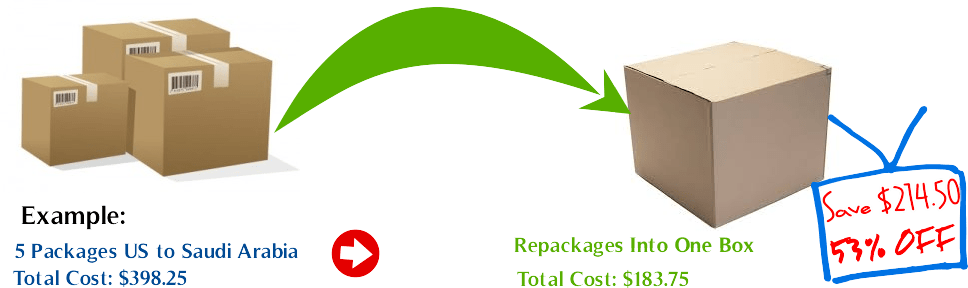
Consolidation means we open the outer shipping boxes from several retailers, remove the air and the excess packaging, and repack everything into one carton. It typically cuts the international shipping cost 30% to 40% per batch. For Canada it does a second job that matters just as much: one carton is one customs entry, which means one clearance charge instead of four.
International rates are front-loaded. The first pound is the most expensive pound, and couriers bill on dimensional weight, so a large box of air costs real money. Four small parcels pay that first-pound premium four times. One dense carton pays it once.
Consolidation is free on the Silver and Gold plans and a paid add-on on Starter. The sibling page on our package consolidation service shows the process, and the international shipping savings guide covers every other lever, from carrier choice to packaging.

When not to consolidate
Consolidation is not always the right call, and we will say so when you ask. Tax and duty are assessed on the total value of the carton, so combining orders never reduces what you owe the government. If each of your orders alone would fall under a low-value threshold, shipping them separately could, in principle, leave each one unassessed, while a combined carton would be taxed. For most real orders that scenario does not apply, because the thresholds are small. It is still worth thinking about for a run of inexpensive items. A single urgent item should also ship alone rather than wait for a batch.
The Cost Math, Worked Honestly
The service has one fixed cost, the plan, and one variable cost, the shipping you approve. Everything Canada charges at the border would apply no matter how the goods reached you.
The fixed part. The Silver Plan is $450 per year. With the bonus month on annual billing, that is 13 months of service, or about $34.62 per month. Starter at $330 works out to about $25.38 per month over the same 13 months, and Gold at $595 to about $45.77.
The variable part, as an illustration. Suppose four separate parcels would cost a combined $200 to ship to Canada at the quoted rates. That figure is an example, not a quote, and your boxes will differ. At the typical consolidation saving of 30% to 40%, the same goods in one carton would ship for roughly $120 to $140. That is $60 to $80 saved on one batch, before counting the three clearance charges that no longer exist. A household that ships a batch like that every other month recovers the difference between Starter and Silver, which is $120 per year, within the first two batches.
What the plan does not change. GST or HST, any PST, and any duty. Budget for them on every order of real value. A useful habit: before you buy, add your provincial sales tax rate to the item price, then add an estimate for shipping. If the total still beats the Canadian retail price, the purchase makes sense. If it does not, buy at home. We would rather you skip an order than resent one.
For a wider view of what mailbox providers charge and where the add-on fees hide, see how much a virtual mailbox costs.
What Cannot Ship to Canada
Three sets of rules apply to every box: what the carrier will fly, what the US allows out, and what Canada allows in. If an item fails any one of them, it does not ship.
Carrier and air-transport limits
Aerosols, perfume and nail polish (both flammable), loose lithium batteries, fuel, and many cleaning chemicals are dangerous goods. Some can move by ground courier with the right paperwork, and some cannot move at all through a forwarder. Devices with a lithium battery installed are usually acceptable within limits.
Canadian import controls
- Weapons and related items. Firearms, parts, ammunition, pepper spray, and certain knives are prohibited or tightly controlled. We do not forward them.
- Cannabis in any form. Legal to buy in Canada, illegal to carry across the border in either direction. That includes CBD products.
- Food, plants, seeds, and animal products. The Canadian Food Inspection Agency restricts many of these. Shelf-stable packaged food is often fine, while meat, dairy, fresh produce, and seeds often are not.
- Alcohol and tobacco. Provincial liquor rules, excise, and carrier policies make these impractical. We do not forward them.
- Prescription drugs and many supplements. Health Canada controls these, and carriers restrict them. Fill prescriptions in Canada.
- Certain consumer products. Health Canada bans some products that are still sold in the US. Baby walkers are the well-known example. Used mattresses and some second-hand goods need certificates.
- Counterfeit goods and currency. Never.
Our full list, which applies to every destination, is in the guide to prohibited commodities for mail forwarding. If you are unsure, ask before you buy. A two-line email costs less than a return.
One more refusal
We do not reship packages for someone you met online, for a “job” that pays you to receive boxes, or under a name that is not on your Form 1583. That pattern is how stolen-card fraud moves goods, and our post on reshipping scams and parcel mules explains why the person holding the box ends up holding the liability.
Border Pickup vs. Forwarding to Your Door
If you live within a comfortable drive of a US border town and cross regularly, a parcel pickup depot at the border may cost you less than any forwarding service, ours included. If you do not, forwarding is the practical route. We are in Tewksbury, Massachusetts, in the Boston area, several hours by road from the nearest Canadian crossing. We are a forwarding service. We are not a border pickup point, and we would rather tell you that now.
Border depots in towns along the Washington, New York, Michigan, and Maine lines hold parcels for a small per-package fee. You drive down, collect, and declare the goods to a CBSA officer on the way home. Your personal exemption depends on how long you were out of Canada, and same-day trips carry little or none, so the tax is still due. What you save is the international freight and the brokerage, and what you spend is fuel, time, and the wait at the bridge.
| Question | Border pickup depot | Forwarding from Massachusetts |
|---|---|---|
| Where you need to live | Within a practical drive of a crossing | Anywhere in Canada, including the North and rural routes |
| International shipping cost | None, you are the carrier | Discounted USPS or courier rate per shipment |
| Brokerage | None, you declare in person | Canada Post handling fee or courier brokerage |
| Tax and duty | Owed, subject to personal exemptions by time away | Owed, subject to low-value thresholds |
| Letter mail, scanning, check handling | Rarely offered | Yes, scanning free on Silver and Gold |
| Works in winter, or without a car | Not well | Yes |
| Address usable for US accounts and IRS mail | Varies, many are parcel-only | Yes, USPS-approved CMRA street address |
Local pickup at our Tewksbury counter is available during business hours, and customers who happen to be travelling through New England do use it. It is a convenience, not a border strategy. If you live in Windsor, Surrey, or Niagara and only want parcels, use a depot. If you live in Calgary, Ottawa, Halifax, or anywhere the drive is not realistic, or if you also need letter mail handled, this service fits.
US Mail for Canadians With US Accounts or Property
A US address solves a paperwork problem that has nothing to do with shopping. Canadians who own US property, hold US financial accounts, or run a US entity receive American mail that is slow, unreliable, or impossible to get in Canada.
US property owners
County property tax bills, HOA assessments, utility notices, insurance renewals, and the occasional code-violation letter go to the mailing address on file. If that address is the vacant condo, nobody reads them for months. If it is your Canadian address, some county systems cannot format it and some senders will not pay international postage. A US mailing address receives everything, and a scan puts the bill in front of you while the early-payment window is still open.
US bank, brokerage, and card accounts
Many US institutions accept a CMRA street address as a mailing address. None of them should treat it as your residence, and you should not present it as one. Tell your bank the truth about where you live and tax-reside, give them the Massachusetts address for mail, and let replacement cards and statements arrive somewhere a person signs for them. We forward cards by tracked courier on request. The details are in keeping a US bank account while living abroad.
IRS and state tax mail
Canadians with US rental income, a US LLC, or an ITIN hear from the IRS by paper letter, and those letters carry response deadlines that start on the date printed at the top. The IRS lets you use a mailing address that differs from your residence. A scan on the day of arrival can be the difference between a simple reply and a penalty. Confirm your filing obligations with a cross-border tax professional. We handle the envelope, not the return.
US companies owned by Canadians
A Canadian who forms a Massachusetts LLC needs a registered agent with a physical address in the state, and a business mailing address is useful alongside it. We offer a Massachusetts Registered Agent service (see current pricing on the site), and the Gold Plan is registered-agent compatible. The rules are laid out in Massachusetts registered agent requirements. For the address itself, see our virtual address page.
When a retailer will not take your Canadian card
Some US stores reject foreign-issued cards or foreign billing addresses even when the shipping address is American. Our Personal Concierge service handles that: our US team makes the purchase for you for a flat $99.95 per purchase request, plus the cost of the goods. It is worth it for a hard-to-get item and not worth it for a $30 one. Details are on the personal concierge service page.
Americans, Snowbirds, and Dual Residents in Canada
If you are an American living in Canada, the service is the same and the priorities flip. Packages matter less. Letters matter more.
Your US bank, your brokerage, the IRS, the Social Security Administration, your state’s unclaimed-property office, and your alma mater all want a US address. A relative’s house works until the relative moves, travels, or forgets a letter in a kitchen drawer. A staffed address logs every piece the day it arrives and emails you. You scan what needs reading, shred what does not, and forward originals, such as a new passport card or a replacement debit card, by tracked courier.
Canadian snowbirds who winter in Florida or Arizona use the address in reverse: the US mail that accumulates at the winter home from April to October goes to Massachusetts instead, and gets scanned or forwarded to Ontario. American snowbirds with a cottage in Canada do the mirror image. The seasonal routine is described in mail forwarding for snowbirds.
One caution for every cross-border household. A mailing address does not establish tax residency, state domicile, or immigration status anywhere, and it does not end them either. Those are questions of fact about where you live and what ties you keep. Our post on state residency, taxes, and your mail explains the principle. For your own situation, confirm with a professional who handles both the CRA and the IRS.
Step by Step: Getting Your US Address
Setup takes four steps, and the only one that needs effort is the notarized form. Canadians complete it from home.
Pick a plan
Choose Starter, Silver, or Gold on the plans page. Shoppers who expect to combine orders should start at Silver, where consolidation and scanning are free.
Complete Form 1583
USPS requires a notarized Form 1583 with two forms of ID before any CMRA can receive your mail. A Canadian passport works as photo ID, and online notarization is accepted.
Receive your address
Once the paperwork is approved, typically within about one business day, we issue your street address and suite number. Use it exactly as written at checkout.
Shop, then ship
We email you when each item lands. When your batch is ready, request consolidation, compare the carrier quotes, approve one, and track the carton to your door.
The detail behind each step
- Form 1583 identification. The form asks for one photo ID and one ID that confirms your home address. The list of acceptable documents is printed on the form itself and USPS revises it from time to time, so read the current PS Form 1583 before your notary session. Our Form 1583 guide walks through every box.
- List everyone who will receive mail. A spouse, an adult child, a business name. Mail for a name that is not on file gets held for verification. Silver covers up to 3 users and Gold up to 5.
- Enter the address correctly at checkout. Put the suite number on the address line where the retailer allows it. If a form rejects the format, email us and we will tell you what works for that retailer.
- Keep invoices. Save the order confirmation for each purchase. We use the values for the customs declaration, and you may need them if the CBSA asks.
- Watch your storage window. 30 days on Starter, 60 on Silver, 90 on Gold. Plan batches inside it.
- Choose the carrier per shipment. Light and modest in value, consider USPS. Heavy, valuable, or urgent, consider express courier. Ask us if the clearance fee is bundled.
Plans and Pricing
Three plans, billed annually with one bonus month, which makes 13 months for the price of 12. Shipping is billed separately at discounted carrier rates, only when you approve a shipment. 3-month and 6-month terms are also available.
Starter Plan
- Real Massachusetts street address with suite number
- All carriers accepted
- Free email alert on every arrival
- 30 days of storage
- Scanning and consolidation available as paid add-ons
- Forwarding to Canada and 220+ countries and territories
Silver Plan
- Everything in Starter
- Free mail scanning
- Free package consolidation
- 60 days of storage
- Up to 3 users
- The usual choice for cross-border shoppers
Gold Plan
- Everything in Silver
- 90 days of storage, up to 5 cubic feet
- Up to 5 users
- Dedicated US fax line
- Registered-agent compatible
- Suits businesses and heavy shoppers
Which plan fits a Canadian customer
Starter fits the Canadian with a US condo or a US bank account who mostly needs letters received and occasionally forwarded. If you will ask for more than a handful of scans in a year, price the add-ons against Silver first.
Silver fits the household that shops US retailers a few times a season. Free consolidation is the feature that pays for itself on shipments to Canada, for the brokerage reason above. Sixty days of storage covers a Black Friday to mid-December batch.
Gold fits resellers, small businesses, and families sharing one account. Ninety days and 5 cubic feet allow a quarterly carton, and the plan pairs with our registered agent service for Canadians who own a Massachusetts entity.
The full feature comparison is on the subscriptions page, and everything else we do is listed under our services.
Mistakes That Make Cross-Border Shipping Expensive
Most of the avoidable cost in US to Canada shipping comes from a small number of habits. We see the same ones every year.
Choosing a courier ground service without asking about brokerage. The freight quote looks low. The bill at the door does not. Ask what the clearance charge will be before you approve, or choose a service where it is bundled.
Shipping every order the day it arrives. Each box pays the first-pound premium and its own clearance fee. Unless something is urgent, let orders collect inside your storage window and ship one carton.
Assuming “bought in the US” means duty-free. CUSMA covers goods that originate in North America. Check the country of manufacture on clothing, shoes, and bags before you assume zero duty.
Forgetting sales tax in the comparison. The US price looks 20% lower until GST or HST and the exchange rate arrive. Do the full sum first.
Ordering restricted items and hoping. A perfume set or a power-tool battery that cannot fly becomes a return you pay for. Ask first.
Leaving a family member off Form 1583. A parcel addressed to your partner, who is not on the form, gets held while we verify. Add everyone at signup.
Treating the address as a residence. It is a mailing and shipping address. Using it to claim you live in Massachusetts, to a bank, an insurer, or a government, creates problems a mailbox cannot fix.
Definitions for any term on this page, from dimensional weight to CMRA, are in our mail forwarding glossary.
Three Typical Setups
These are composites of the patterns we see most often, not individual customers.
The Ottawa family that shops seasonally
Two adults on a Silver Plan. They order kids’ clothing, hockey gear, and a few tools during US sale weeks, and let the orders collect for five or six weeks. One consolidated carton goes out by express courier with clearance bundled. They pay HST once, on one entry, and they receive one delivery instead of seven.
The Alberta couple with a Phoenix condo
A Starter Plan with occasional paid scans. Maricopa County tax notices, HOA statements, and the insurer’s renewal all go to Massachusetts. Most items are scanned and shredded. Twice a year, originals that matter travel north in one USPS envelope, delivered by Canada Post to a rural route no courier serves well.
The American in Montreal
A US citizen, ten years in Quebec, on Silver. IRS letters, a US brokerage, a Massachusetts credit union, and an absentee ballot each election year. Almost nothing is forwarded physically. The scan arrives, the reply goes out online, and a new debit card travels by tracked courier once every few years. The lifestyle side is in our guide for American expats in Canada.
Frequently Asked Questions
How does US mail forwarding to Canada work?
You rent a real US street address with a suite number at our staffed Massachusetts facility. US senders and retailers ship there, we email you on every arrival, and you choose to scan, hold, consolidate, or forward. Shipments travel to Canada by USPS and Canada Post or by FedEx, UPS, or DHL after you approve the quote.
Can a Canadian get a US address without living in the United States?
Yes. Any Canadian can open a mailbox at a USPS-approved CMRA by completing USPS Form 1583 with two forms of identification and having it notarized. A Canadian passport is accepted as photo ID, and online notarization is accepted, so the whole setup can be done from home in Canada.
Will I pay duties and taxes on packages forwarded to Canada?
Usually you will pay GST or HST, and in some provinces PST, on anything above a low threshold. Duty depends on where the goods were made. Items originating in North America are generally duty-free under CUSMA, while goods made elsewhere may not be. Verify current thresholds and rates with the CBSA.
Is USPS or a courier cheaper for shipping from the US to Canada?
It depends on the box. USPS with Canada Post delivery often wins for light, lower-value parcels because the clearance charge is a flat handling fee. Express couriers often win for heavy consolidated cartons, especially on services that bundle customs clearance. We quote both so you can compare on your actual shipment.
How does package consolidation reduce brokerage fees?
Each courier shipment is a separate customs entry and can carry its own brokerage charge. Consolidation combines several orders into one carton, which means one entry and one clearance charge. It also typically cuts the shipping cost 30% to 40% per batch. Taxes and duty on the goods themselves stay the same.
Can I drive down and pick up my packages instead of forwarding them?
You can collect at our Tewksbury counter during business hours, but we are in the Boston area, several hours from the nearest Canadian crossing. If you live near the border and only want parcel pickup, a border depot will suit you better. Our service is built for forwarding to your door anywhere in Canada.
What items cannot be forwarded to Canada?
We do not forward weapons, ammunition, pepper spray, cannabis or CBD products, alcohol, tobacco, prescription drugs, counterfeit goods, or currency. Aerosols, perfume, and loose lithium batteries face air-transport limits. Many foods, plants, and seeds are restricted by the Canadian Food Inspection Agency. Ask us before you buy anything questionable.
Can I use the address for my US bank, brokerage, or IRS mail?
Yes, as a mailing address. Many US institutions accept a CMRA street address for correspondence, and the IRS allows a mailing address that differs from where you live. It is not proof of US residence and should never be presented as one. Tell each institution where you actually reside.
How long does forwarding from the US to Canada take?
We do not promise transit times. Express couriers publish the fastest estimates, and postal service is slower, particularly when customs volume is high around the holidays. What we control is processing: approved shipments leave our facility on business days, Monday through Friday, 9:00 AM to 5:30 PM Eastern.
What does a US address for Canadians cost?
The Starter Plan is $330 per year, Silver is $450, and Gold is $595. Annual billing includes one bonus month, so you get 13 months for the price of 12. Silver and Gold include free scanning and free consolidation. Shipping to Canada is billed separately at discounted carrier rates when you approve it.
Get Your US Address and Ship to Canada on Your Terms
A real Massachusetts street address, a staffed counter that has been open since 2007, and one consolidated carton instead of a pile of brokerage bills. Annual plans include a bonus month.