
American Expats, Virtual Mailbox
How to Deposit US Checks While Living Abroad (2026)
Oct
To deposit US checks while living abroad, you have five real options: move the payer to direct deposit, have the check forwarded to you by tracked courier and deposit it with your US bank’s mobile app, mail the endorsed check to your bank’s deposit-by-mail address, try your foreign bank, or authorize a trusted person in the US. Only the first one is a permanent fix. The other four are fallbacks for the checks you cannot stop.
Key Takeaways
- Every paper check you convert to direct deposit or ACH is a check you never have to chase again. Start there, payer by payer.
- Mobile deposit works from abroad at many US banks, but you need the physical check in your hands, so it has to travel to you by tracked courier first.
- Deposit by mail only works if your bank offers it and the check is endorsed by you. Nobody else can sign it for you without legal authority.
- Foreign banks often refuse USD checks, and when they accept them the collection process is slow and the fees are high.
- Checks go stale. Many banks will not honor a personal or business check older than about six months, so speed matters.
- A check sitting in an unattended mailbox is a fraud risk. A staffed address with arrival alerts and scanning tells you a check exists the day it lands.
Table of Contents
- The Five Ways to Deposit a US Check From Abroad
- Stop the Paper First: Direct Deposit and ACH
- Mobile Check Deposit From Abroad
- Deposit by Mail From the US Side
- Depositing a USD Check at a Foreign Bank
- Power of Attorney or a Trusted Relative
- Check Source by Check Source: What to Do
- How Long You Have Before a Check Goes Stale
- Fraud Risk, Unattended Mailboxes, and Scanning First
- A Working Routine, Step by Step
- What People Get Wrong
- Frequently Asked Questions
The Five Ways to Deposit a US Check From Abroad
Short version from someone who handles expat mail every working day: you either stop the check from being printed, get the paper to a place where it can be deposited, or hand the job to someone with legal authority to do it. Everything you read in forum threads is a variation on one of those three ideas.
Here are the five methods, ranked by how often they work without drama:
- Switch the payer to direct deposit or ACH. No paper, no courier, no expiry clock. Works for most recurring payers and a fair number of one-off ones.
- Mobile deposit with your US bank’s app. You photograph the front and back of the check. This requires the physical check in your hand, which means forwarding it to you abroad.
- Deposit by mail. Some US banks and credit unions publish a mailing address for deposits. The endorsed check goes there in an envelope and posts to your account a few days after it arrives.
- Your foreign bank. Some will take a USD check for collection. Many will not. Expect weeks and fees.
- A trusted person with authority. A joint account holder, or someone holding a power of attorney your bank has accepted, deposits for you in the US.
All five assume you still have a US account to deposit into. If yours is at risk because of your foreign address, read our guide on keeping a US bank account while living abroad before you worry about individual checks. Without the account, none of this works.
Stop the Paper First: Direct Deposit and ACH
The best way to deposit a check from abroad is to never receive it. Most organizations that mail you a check will pay electronically if you ask, and the ones that send checks every month or every quarter are exactly the ones worth a phone call.
IRS refunds
The IRS pays refunds by direct deposit into a US account when you put the routing and account number on your return. If you filed without bank details, you get paper, and paper mailed to a foreign address is slow and easy to lose. The federal government has been moving away from paper checks generally, so check the current rules and your refund status at irs.gov/refunds. A US routing number is required, which is one more reason to protect your US account.
Social Security
The Social Security Administration pays by direct deposit to US banks, and it also offers international direct deposit to banks in many countries, paid in local currency. The country list and enrollment steps change, so confirm what applies to you at ssa.gov or through the Federal Benefits Unit that covers your country. We cover the mail side of both agencies in IRS and Social Security mail while living abroad.
Dividends, pensions, and annuities
Dividend checks usually come from a transfer agent, not the company itself. Log in to the transfer agent’s site, or call, and add bank details for ACH. Better still, move directly held shares into a brokerage account so dividends land as cash there. Pension and annuity administrators nearly all offer direct deposit and simply never asked you.
Rent and private payers
A tenant or a property manager who mails a check every month can pay by bank transfer, Zelle, or an online rent platform tied to your US account. This is a five-minute conversation that removes twelve checks a year.
The checks you cannot stop
Class action settlements, insurance claim payments, escrow refunds, utility deposit refunds, and rebates are one-off payments from payers you will never deal with again. Some settlement administrators offer an electronic option on the claim form, so look for it. The rest will arrive as paper, and that is what the next four sections are for.
Mobile Check Deposit From Abroad
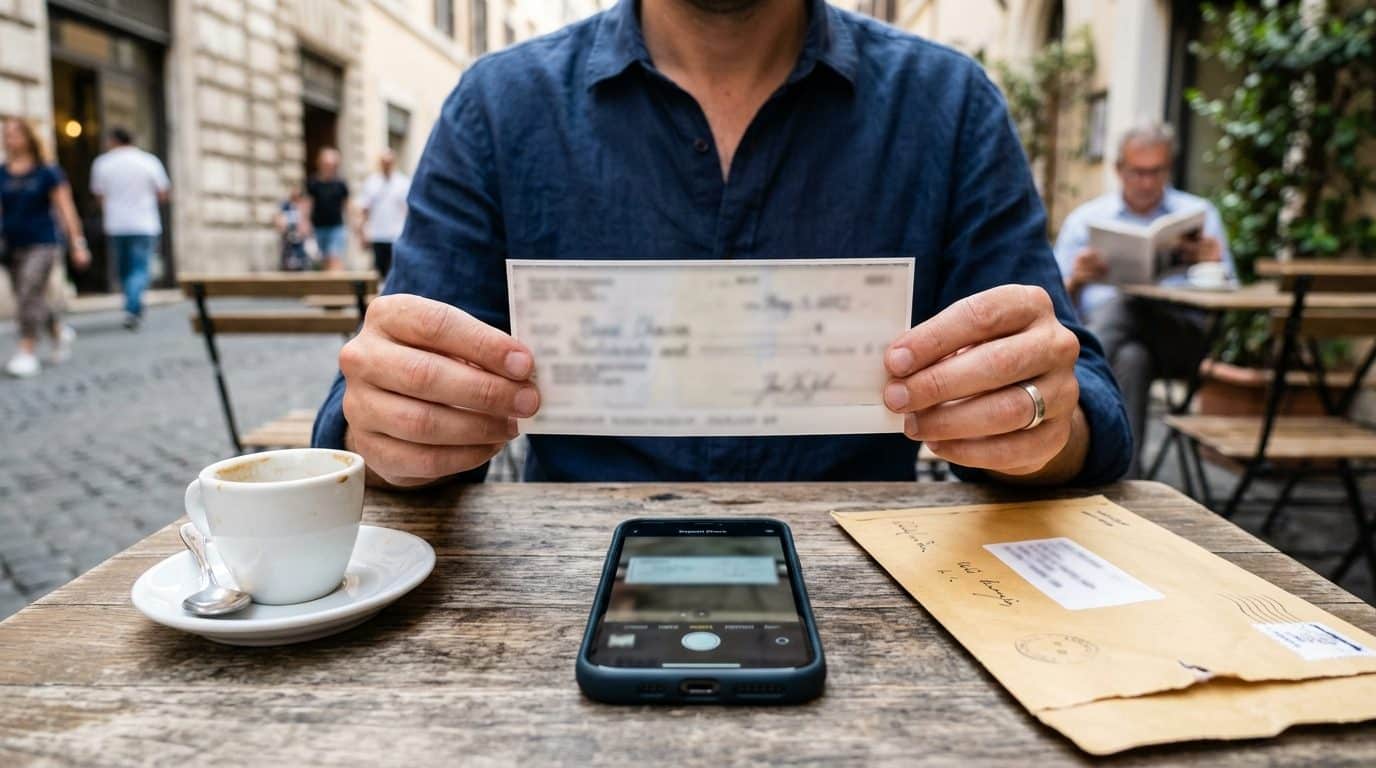
Yes, you can often use mobile check deposit from another country, but only with the physical check in front of you. The app needs photos of the front and the endorsed back, taken by you. A scan emailed by someone else is not a substitute, and most bank agreements prohibit depositing an image you did not capture from the original item.
That makes the real question logistics. The check has to get from a US mailing address to your kitchen table without disappearing. Regular international letter post is cheap and untracked, and it is the wrong tool for a negotiable instrument. Use a tracked courier. When a check lands at a staffed US address, it can go out by FedEx, UPS, or DHL in a document envelope with tracking from door to door. That is the core of what a mail forwarding service does for expats, and it is how most of our overseas subscribers handle the checks they cannot convert.
What varies by bank
- Deposit limits. Banks cap mobile deposits per item, per day, and per month. A large insurance or escrow check can exceed the cap. Ask your bank what your limits are and whether they can be raised.
- Endorsement wording. Many banks require your signature plus a phrase such as “For mobile deposit only” and sometimes the bank name. A missing phrase is a common reason for rejection.
- App access abroad. Some banking apps behave differently on a foreign network or are missing from foreign app stores. Test a small deposit before you depend on it.
- Hold times. Funds from mobile deposits can be held for several business days, longer for large or unusual items.
Confirm all four with your own bank. After the deposit is accepted, keep the paper check somewhere safe until the funds have fully cleared and your bank’s stated retention period has passed, then destroy it.
Deposit by Mail From the US Side
Deposit by mail works if your bank offers it, and the catch is the endorsement. A number of US banks and credit unions publish a deposit-by-mail address. An endorsed check sent there, usually with a deposit slip or your account number written on the back, posts to your account after it arrives.
The check must be endorsed by you, the payee. That is the part people skip over. A mail service cannot sign your name. So in practice deposit by mail from abroad goes one of two ways:
- The check comes to you first. It is forwarded by courier, you endorse it, and you mail it to the bank’s deposit address yourself. This makes sense only when mobile deposit is unavailable or the amount is over your mobile limit.
- A standing arrangement. Some banks accept certain checks for deposit to the payee’s own account under their own rules, and some customers set up arrangements with their bank in advance. This is entirely your bank’s decision, so get their answer in writing before you rely on it.
To be plain about our role: we receive, log, scan on request, and forward your mail. We do not deposit checks on a customer’s behalf, and we do not endorse anything. A mail service can forward an already endorsed check to your bank’s deposit-by-mail address if your bank offers one. If you have a specific setup in mind, ask us what we can do for your situation and we will tell you honestly whether it fits.
If you do mail a check to a bank, use a tracked service, write “For deposit only” with your account number under your signature, and photograph both sides before it leaves your hands.
Depositing a USD Check at a Foreign Bank
You can try, but expect a no, and if you get a yes, expect it to be slow and expensive. US checks clear through the US banking system. A bank in Portugal or Thailand has to send the item back to a US correspondent bank for collection, and many have stopped offering the service to retail customers at all.
Where it is still offered, the pattern looks like this:
- The bank takes the check “for collection,” not as a normal deposit. You see no funds until the US bank pays.
- Collection commonly takes several weeks.
- Fees are charged by your bank, sometimes by the correspondent bank, and the currency conversion happens at the bank’s own rate.
- Small checks can cost more to collect than they are worth. A twenty-dollar class action check is usually not worth presenting abroad.
Banks in Canada are the main exception, because USD accounts are common there and cross-border checks are routine. Even so, holds are long. If you are in Canada, our page on mailboxes for American expats in Canada covers the cross-border mail side. For everyone else, the foreign bank is the last resort, useful mainly when you have no US account left.
Power of Attorney or a Trusted Relative
A person in the US can deposit for you only if the bank recognizes their authority. Your sister cannot sign your name on the back of your check, however well meant. There are two clean ways to do this.
Joint account holder
If a spouse or family member is a joint owner of the account, and the check is payable to you, many banks will accept it for deposit into the joint account. Policies differ on whether both payees must endorse. Ask the bank.
Power of attorney
A financial power of attorney lets your agent endorse and deposit on your behalf. Banks are cautious with POAs. Many want their own form, or want to review and approve yours before the first transaction. Set this up before you leave the US if you can. Signing a POA abroad usually means a US consulate notarization or a remote online notary your bank accepts. This is a legal document with real consequences, so confirm the details with an attorney.
The honest trade-off: a relative is free, and for a couple of checks a year it can be the right call. It also puts your financial mail in a home mailbox, depends on someone else’s schedule, and mixes family with money. We compare the two approaches in family address vs. virtual mailbox for expats.
Check Source by Check Source: What to Do
The right move depends on who is paying you. Recurring payers should be converted to electronic payment once. One-off payers should be handled with the fastest fallback you have available.
| Check source | Best way to stop receiving paper | Fallback if paper arrives |
|---|---|---|
| IRS tax refund | Enter US routing and account number on the return for direct deposit (verify at irs.gov) | Forward by tracked courier, then mobile deposit. Treasury checks print their own void-after date. |
| State tax refund | Choose direct deposit on the state return | Courier plus mobile deposit |
| Social Security | Direct deposit to a US bank, or international direct deposit where offered (verify at ssa.gov) | Contact SSA or the Federal Benefits Unit. Do not let benefit checks pile up. |
| Dividends | Add ACH details with the transfer agent, or move shares to a brokerage | Courier plus mobile deposit. Tiny checks: ask the agent to reissue electronically. |
| Pension or annuity | Direct deposit form from the plan administrator | Courier plus mobile deposit |
| Rental income | Bank transfer, Zelle, or an online rent platform | Courier plus mobile deposit, or a joint account holder |
| Insurance claim or refund | Ask the adjuster for EFT before the payment is issued | Courier plus mobile deposit. Check your mobile limit on large amounts. |
| Class action settlement | Select the electronic payment option on the claim form if offered | Courier plus mobile deposit. Watch the short void date. |
| Escrow, utility, or rebate refund | Usually cannot be stopped | Courier plus mobile deposit, or request a reissue if stale |
One detail that helps with all of these: give every payer the same stable US mailing address. A real street address at a staffed center is accepted in more places than a PO Box, and our piece on whether you need a US address while living abroad walks through who actually requires one.
How Long You Have Before a Check Goes Stale
Treat every check as if it expires in a few months. Under the rules most US banks follow, a bank is not obligated to pay an ordinary check presented more than about six months after its date. Such a check is called stale-dated. The bank may still pay it, but it may also refuse, and you do not want to find out after paying for a courier.
Some checks are tighter than that:
- “Void after 90 days” or “void after 180 days” printed on the face. Common on settlement, rebate, and payroll checks. The printed date is the one that matters in practice.
- US Treasury checks carry their own validity period printed on the check, longer than a typical business check. Read the face of the check and confirm with the issuing agency.
- Cashier’s checks and money orders do not go stale the same way but can be turned over to a state as unclaimed property after a dormancy period.
Getting a stale check reissued
If a check has expired, do not try to deposit it. Contact the payer, explain that the check is stale-dated, and ask for a replacement. Most will want the original returned or a signed statement that it was not cashed. Some charge a reissue fee. If the payer has already sent the money to a state unclaimed property office, you claim it from that state instead, which is free but slow. The practical lesson is that the clock starts on the date printed on the check, not the day you learn about it. Which brings us to knowing it arrived.

Fraud Risk, Unattended Mailboxes, and Scanning First
A check in an unattended mailbox is the single worst place for it to be. Stolen checks get altered and cashed, a practice known as check washing, and the payee often does not find out for months. When you live abroad, a curbside box at a former home or an empty rental is exactly the target thieves look for. We go through how this happens and what to do about it in how to prevent mail theft and check fraud.
The fix has two parts. First, send check mail to an address where a person receives it and puts it behind a counter. Our Tewksbury, Massachusetts center is a USPS-approved CMRA, staffed Monday to Friday, 9:00 AM to 5:30 PM Eastern, and mail is handled in-house by background-checked staff. It is a real street address with your own suite number, not a PO Box.
Second, know what arrived. Every plan includes a free email alert on each arrival. With our mail scanning service, you can ask for an envelope to be opened and scanned to PDF. For a check, the scan tells you the payer, the amount, the date, and any void-after language. It is not a deposit image. It is information, and it lets you decide whether this check is worth a courier today, can wait for the next batch, or is small enough that you would rather ask the payer for an electronic reissue.
That decision is where money gets saved. Shipping one twelve-dollar dividend check by courier makes no sense. Shipping four checks in one tracked envelope does.
A Working Routine, Step by Step
Here is the routine that works for most of our subscribers abroad. It takes an afternoon to set up and then runs quietly in the background.
- Get a stable US address. Open a mailbox at a staffed center and complete USPS Form 1583 with two IDs. Online notarization is accepted, so you can do this from abroad. If you are new to the idea, how to get a US address covers the basics.
- List every payer that has mailed you a check in the last two years. Bank statements show them as check deposits.
- Convert the recurring ones. Call or log in, add ACH details. Expect this to remove most of your paper.
- Give the rest your new mailing address. Use your virtual address as the mailing address. Some banks treat mailing and residential addresses differently, which we explain in what to do when a bank rejects a virtual mailbox address.
- Confirm your bank’s mobile deposit rules for use abroad: limits, endorsement wording, holds.
- When an alert arrives, request a scan. Note the check date and any void-after line.
- Batch and ship by tracked courier. Group checks with other mail worth having. Urgent or large items ship on their own.
- Endorse, deposit, keep the paper until cleared, then shred.
What it costs
The Silver Plan is $450 per year and includes free mail scanning, which is why most expats with financial mail choose it. The Starter Plan is $330 per year with scanning available as a paid add-on, a fair choice if you expect only a handful of items. Annual billing on either includes one bonus month, so 13 months for the price of 12. Courier charges are billed at discounted carrier rates and depend on destination and speed, so we do not quote a number here. Compare the plans on the plans and pricing page, or read how much a virtual mailbox costs for the wider market. If you receive two small checks a year, a relative is cheaper and may be good enough. If your checks are refunds, insurance payments, or rent, one lost item costs more than the plan.
What People Get Wrong
The same mistakes show up in nearly every forum thread on this topic. Most come from treating a check like an ordinary letter.
- “Someone can just email me a photo and I will deposit that.” Your bank agreement almost certainly requires you to capture the image from the original check in your possession. Depositing a forwarded image can get the deposit reversed or your mobile deposit access removed.
- “My mail service can deposit it for me.” A mail service cannot endorse your check. Be cautious of anyone who says otherwise without explaining the legal basis. We do not deposit checks for customers.
- “It is a government check, so it never expires.” Treasury checks have a printed validity period too. It is longer, not unlimited.
- “My foreign bank will take it, they take everything.” Ask before you count on it. Many have ended USD check collection for personal accounts.
- “USPS forwarding will send it to me overseas.” USPS change-of-address forwarding runs for a limited period, and it does nothing to protect a check travelling by ordinary untracked post. Check usps.com for the current rules on forwarding to a foreign address. See USPS vs. private mail forwarding.
- “I will deal with checks when I visit next summer.” A check dated in September can be stale by the following spring. Visits are not a plan.
- Ignoring the address on file. Payers mail to whatever address they have. If that is an apartment you left in 2023, the check went there. Update the address even with payers you have converted, because exceptions still generate paper.
One related point: if your US bank and card issuers are part of the same worry, our guide to keeping US credit cards while living abroad covers replacement cards, which travel the same way checks do. For terms like CMRA, endorsement, and consolidation, the mail forwarding glossary has plain definitions.
Frequently Asked Questions
Can I deposit a US check with my bank’s mobile app while I am outside the United States?
Often yes. Many US banks allow mobile deposit from abroad, but you must photograph the original check yourself, so it has to be forwarded to you first. Limits, endorsement wording, hold times, and app availability on foreign networks vary by bank. Confirm the rules with your bank and test with a small check before relying on it.
Can someone in the US deposit a check made out to me?
Only with authority your bank recognizes. A joint account holder can often deposit a check payable to you into the joint account, and an agent under a financial power of attorney the bank has accepted can endorse on your behalf. A friend signing your name is not valid. Ask your bank which documents it requires.
Will a mail forwarding service deposit my checks for me?
MyMailForwarder.com does not deposit checks on a customer’s behalf and cannot endorse them. We receive your mail at a staffed Massachusetts address, alert you, scan on request, and forward by tracked courier. If your bank offers deposit by mail and you have a specific arrangement in mind, contact us and ask what we can do for your situation.
How long is a US check valid?
Banks are generally not required to honor an ordinary check presented more than about six months after its date, and many settlement or rebate checks print a shorter void-after period such as 90 days. US Treasury checks print their own, longer validity period. Read the face of the check and ask the payer to reissue anything that has expired.
Can I deposit a US dollar check at a bank in my new country?
Sometimes, but it is the weakest option. Many foreign banks no longer accept USD checks from personal customers. Those that do usually send the check to the US for collection, which commonly takes weeks and carries fees plus the bank’s own exchange rate. For small checks the cost can exceed the value.
How do I stop receiving paper checks from the IRS and Social Security?
For IRS refunds, enter a US bank routing and account number on your tax return to receive direct deposit. For Social Security, enroll in direct deposit to a US bank, or in international direct deposit where SSA offers it for your country. Rules change, so verify the current options at irs.gov and ssa.gov.
Is it safe to send a check overseas by regular mail?
It is risky. Ordinary international letter post is usually untracked, slow, and hard to trace if it goes missing, and a lost check means a stop payment and a reissue request. A tracked courier envelope from FedEx, UPS, or DHL costs more but gives door-to-door tracking. Grouping several checks into one shipment keeps the cost reasonable.
What should I do with the paper check after a mobile deposit?
Write the deposit date on it and store it somewhere secure until the funds have fully cleared and the retention period your bank states has passed. Then shred it. Do not throw an intact check in the trash, and never deposit the same check twice through different channels, which banks treat as fraud.
Get Your Checks to an Address Where Someone Is Watching
Convert every payer you can to direct deposit. For the checks that still arrive, give them a staffed Massachusetts street address, an alert the day they land, a scan so you know the amount and the date, and a tracked courier to wherever you live. Neighborhood Parcel has run this counter in Tewksbury since 2007 and forwards to more than 220 countries and territories. Our mailbox rental plans start at $330 per year.
Compare plans and open your mailbox, or contact us with your situation and we will tell you plainly what we can and cannot do.
