
Mail Forwarding Service, Virtual Mailbox
RV Mailbox and Mail Forwarding for Full-Time Travelers
Sep
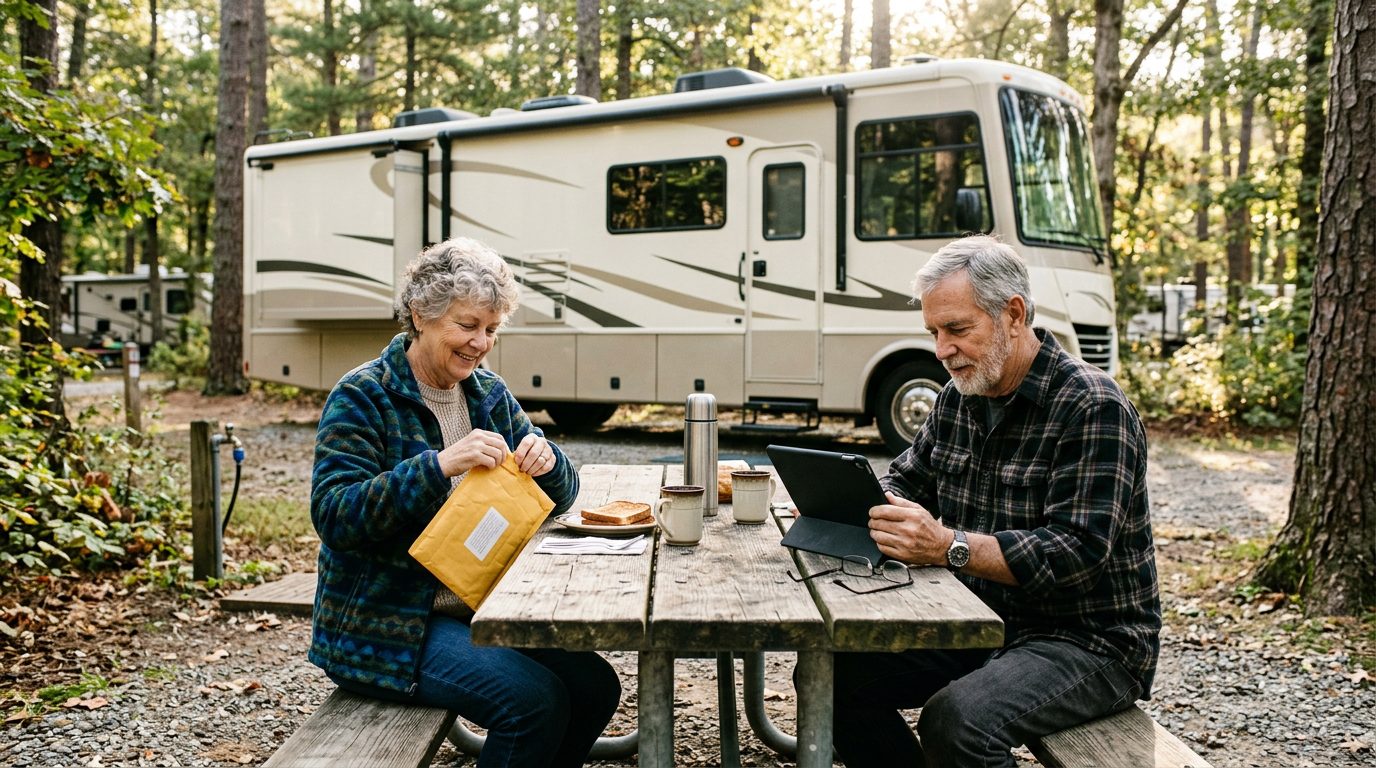
An RV mailbox is a permanent street address at a staffed mail facility that receives your mail and packages while you travel. Staff log each item and email you, you ask for a scan or a hold, and physical mail ships in batches to wherever you will be next: a campground office, a post office via General Delivery, a marina, or a friend’s house.
Key Takeaways
- Full-time travel breaks the assumption every sender makes, that one person has one fixed address. A mail forwarding service restores that fixed point.
- A mailing address and a legal domicile are two different things. Many full-time RVers choose South Dakota, Texas, or Florida as a domicile for tax and vehicle reasons and use a mail service there.
- A Massachusetts address like ours is a strong mailing address, and a sensible one for people with Massachusetts or New England ties, or for people who mainly need mail scanned and forwarded. By itself it does not establish domicile anywhere, and Massachusetts has a state income tax.
- Most full-timers run scan-first: read nearly everything as a PDF, and ship a physical batch only every few weeks.
- Forwarded mail can go to campgrounds, General Delivery, marinas, carrier pickup points, and friends. Amazon Lockers only accept Amazon’s own orders.
- Prescriptions, vehicle registration, insurance, and voting each have rules tied to where you legally reside, not to where your mail goes.
Table of Contents
- Why Full-Time Travel Breaks Normal Mail
- Domicile vs. Mailing Address: The Honest Version
- USPS Forwarding vs. a Family Member vs. a Mail Service
- How a Mail Service Works on the Road
- Where Forwarded Mail Can Go
- Timing Your Batches
- Prescriptions and Medical Mail
- Vehicle Registration and Insurance Mail
- Voting While You Travel
- Nurses, Remote Workers, Cruisers, and Sailors
- Setting It Up, and What It Costs
- Frequently Asked Questions
Why Full-Time Travel Breaks Normal Mail
Mail is built on the idea that you will be at one address next month. Sell the house, move into a fifth wheel, and that idea fails for every sender at once.
The failures are predictable. A vehicle registration renewal goes to the house you sold and is returned as undeliverable. A replacement debit card sits in a campground office in Utah three weeks after you left for Oregon. A jury summons, a toll notice, or an insurance cancellation warning arrives somewhere nobody is looking, and the first you hear of it is the late fee. Online orders are their own problem: FedEx and UPS do not follow a USPS forwarding order, and half of the campgrounds you stay at do not accept packages at all.
People solve this one of three ways. They stretch USPS forwarding as far as it goes. They ask a family member to collect and sort. Or they rent a permanent address from a mail forwarding service and manage everything from a phone. Each works for some travelers, and the comparison further down is meant to help you pick honestly. First, the subject that causes the most confusion among new full-timers.
Domicile vs. Mailing Address: The Honest Version
Your mailing address is where your mail goes. Your domicile is the state you legally belong to: the one that taxes your income, registers your vehicles, issues your driver’s license, summons you for jury duty, and lets you vote. They can be the same place. For full-time travelers they often are not, and a mailbox alone never creates a domicile.
Why so many RVers choose South Dakota, Texas, or Florida
Those three states have no state income tax, and each has a long-established community of mail services set up for travelers. Depending on the state, full-timers also point to vehicle registration costs, inspection requirements, insurance rates, and how easy it is to get a driver’s license with a mail-service address. South Dakota in particular is known for a short in-person visit to establish a license. RVers who pick one of these states usually rent their mailbox there too, so that the license, registration, voter record, and mailing address all line up. If no state has a claim on you and your priority is tax and registration, that is a reasonable plan, and we are not the right provider for it.
Where a Massachusetts address fits
Our facility is in Tewksbury, Massachusetts. Massachusetts has a state income tax, and it is not a state people adopt for domicile advantages. A Massachusetts address makes sense in these situations:
- You are keeping Massachusetts or New England ties: a home you rent out, family, an employer, a business, doctors, a return date.
- You already have a settled domicile somewhere and only need a reliable place for mail to be received, scanned, and forwarded.
- You travel for a year or two and intend to come back.
- You move between countries and want one stable US address for banks, the IRS, and shopping, independent of wherever you currently are.
In each case the mailbox does logistics. It does not make you a Massachusetts resident if you are not one, and it does not end your Massachusetts residency if you are. States look at the whole picture: where you are licensed and registered to vote, where your vehicles are registered, where you work, how many days you spend, and what you told your bank and your insurer. A state that believes you still live there will keep taxing you no matter where your envelopes land.
What to do before you sell the house
Decide your domicile deliberately, with a tax professional, before you choose a mail service. Then make your documents consistent with that decision. Our post on state residency, taxes, and your mail explains how states test residency and why the mailing address is only one line of evidence. This article is general information, not tax or legal advice.

USPS Forwarding vs. a Family Member vs. a Mail Service
There are three workable ways to receive mail without a fixed home. The right one depends on how long you will be gone, how much of your mail carries deadlines, and whether you receive packages.
| Factor | USPS forwarding and Hold Mail | Family member or friend | Mail forwarding service |
|---|---|---|---|
| Cost | Low or free for standard forwarding, weekly fee for premium forwarding | Free, plus postage and goodwill | From $330 per year with us, plus postage on shipments |
| How long it works | Temporary. Hold Mail is capped at 30 days, and a temporary change of address runs for a limited period | As long as they are willing and stay put | Indefinitely, the address does not change |
| Needs a fixed destination | Yes, one forwarding address at a time | No, but they must mail to each stop | No, each batch goes wherever you say |
| FedEx, UPS, DHL, Amazon packages | Not covered | Accepted if someone is home | Accepted and signed for by staff |
| See mail before it ships | No | Only if they open it and photograph it | Yes, email alert on every arrival, scans on request |
| Privacy | Good | They see your bank, medical, and tax mail | Background-checked staff, in-house handling |
| Junk mail | Forwarded along with the rest, depending on class | Depends on their patience | Shredded on your instruction |
| Failure mode | Expires quietly, mail returns to sender | Illness, vacation, a move, a forgotten drawer | You ignore the alert emails |
When USPS is enough. A trip of a few weeks to a few months with a home to come back to. File a temporary change of address or a Hold Mail request on the USPS forwarding page and spend the money on fuel. It stops being enough when there is no home base, because forwarding needs a fixed address at both ends and it does expire.
When family is enough. You have a reliable, stationary relative, low mail volume, and nothing in the mail you mind them reading. Many full-timers start this way. Most who switch do so after a missed deadline or when the relative’s own life changes. If you stay with this option, make it easy for them: prepaid envelopes, a standing schedule, and clear permission to open anything official.
When a service earns its fee. No fixed base, mail with deadlines, packages from private carriers, or a wish to keep family out of your finances. The longer comparison, including the premium USPS program, is in USPS vs. private mail forwarding.
How a Mail Service Works on the Road
You get a real street address with a personal suite number, every sender writes to it, and you manage what arrives from your phone. For a traveler, the value is that paper turns into decisions you can make from anywhere with a signal.
Our address is at a staffed business center in Tewksbury, Massachusetts. We are a USPS-approved Commercial Mail Receiving Agency (CMRA), so the address receives USPS mail and also UPS, FedEx, DHL, and Amazon deliveries. It is not a P.O. Box. When an item arrives, we log it and send a free email alert, on every plan. Then you choose:
- Scan. We open the envelope and send a PDF. This is how most travelers read most of their mail. Scanning is free on Silver and Gold and a paid add-on on Starter. The sibling page on our mail scanning service explains how it works and how scans are handled.
- Hold. Storage is included for 30 days on Starter, 60 on Silver, and 90 on Gold.
- Forward. We quote the batch by carrier, you approve, and it ships with tracking. We forward within the US and to 220+ countries and territories at discounted USPS, FedEx, UPS, and DHL rates.
- Shred. Catalogs and credit card offers do not need a road trip.
Opening the mailbox requires USPS Form 1583, notarized, with two forms of ID. That is federal postal policy for every CMRA, and online notarization is accepted, so you can complete it from a campsite. Our Form 1583 guide goes through it. The general mechanics are on our mail forwarding page, and the address itself is described under virtual address.
Where Forwarded Mail Can Go
A batch can be sent to any address that will accept it and hold it until you arrive. Whether a place will accept it depends on the place and on the carrier, so confirm both before you ask us to ship.
Campgrounds and RV parks
Many private parks accept mail and packages for registered guests. Many public campgrounds, including most state and national park sites, do not. Call the office first and ask four things: do you accept guest mail, which carriers deliver to you, how should it be addressed, and how long will you hold it. The usual format is your name, “Guest” or your site number and arrival date, then the park’s street address. Ship so the batch arrives after you do. Offices return or refuse mail for people they do not recognize.
USPS General Delivery
General Delivery is a USPS service for people without a local address. Mail is addressed to your name, the words GENERAL DELIVERY, and the city, state, and ZIP of a post office that offers it, and you collect it at the counter with photo ID. Three cautions. Only USPS can deliver to General Delivery, so the batch must ship by USPS and not by FedEx or UPS. Not every post office provides it, and in cities it is often limited to one main office, so call that office to confirm. Post offices hold General Delivery mail for a limited time, commonly up to 30 days, and then return it. In small towns it is often the most dependable option there is.
Marinas
Most marinas accept mail for slip holders and transient guests, addressed with your name, your vessel name, and the marina’s street address. Confirm with the dockmaster, particularly regarding packages and hold times. For cruisers outside the US, a marina or a yacht agent is often the only workable delivery point, and the shipment goes by international courier with customs paperwork. Some countries have special treatment for parts sent to a vessel in transit, which varies by country and is worth asking a local agent about before anything ships.
Amazon Lockers and carrier pickup points
Here is a point that catches people out. An Amazon Locker only accepts orders shipped by Amazon to that locker. We cannot forward your mail to one, and neither can any other forwarder. Lockers are still useful on the road for your own Amazon purchases, which you can send directly to a locker near your next stop and skip us entirely. For forwarded batches, the equivalent is a carrier pickup point: a staffed FedEx or UPS location that holds a package for collection with ID, or USPS Hold for Pickup at a post office. Tell us you want the batch held at a carrier location and we will set up the shipment that way where the carrier offers it.
Friends and family along the route
The simplest option is often a person with a front door. If you will be visiting someone in three weeks, send the batch there, addressed to you in care of them. Let them know it is coming. A box for a stranger’s name is how packages get refused.
Hotels and short-term rentals
Hotels usually accept packages for guests with a reservation, marked with your name and arrival date. Short-term rentals are riskier, because the host may not allow it and the mailbox may not be secure. Ask first.
Timing Your Batches
Ship to where you will be, not to where you are. Almost every lost batch on the road was sent to a place the traveler had already left.
A workable rhythm looks like this:
- Read by scan as mail arrives. Deadlines get handled the same week, online or by phone. The physical piece is then usually unnecessary.
- Ship physical mail every three to six weeks, timed to a stop where you will stay at least a week. Plan storage around your plan’s window: 30, 60, or 90 days.
- Request the shipment early. We process on business days, Monday through Friday, 9:00 AM to 5:30 PM Eastern. A request made Friday evening is handled Monday. We do not promise transit times, so add a margin.
- Pick the carrier for the destination. USPS for General Delivery and P.O. Boxes. FedEx or UPS for a park office that only takes those carriers. Anything valuable ships with tracking and, if you wish, signature.
- Ship urgent originals alone. A replacement card or a new license should not wait for a batch. Send it by express to a confirmed address.
- Watch seasonal stops. Parks that close for winter stop accepting mail without telling anyone.
Packages follow the same logic. Orders from several retailers can be consolidated into one carton, which is free on Silver and Gold. Consolidation’s 30% to 40% typical saving applies to international shipments, which matters to travelers abroad. For a domestic batch the benefit is simpler: one box to collect instead of five. Our shipping savings guide covers the international math.

Prescriptions and Medical Mail
Medication should go from the pharmacy to your physical location, not through a mail forwarder. Paperwork about your health coverage is the opposite: it belongs at your permanent address, where it gets logged and scanned.
Medication
Forwarding prescription drugs adds days, exposes them to heat or cold, and runs into carrier restrictions, and controlled substances carry stricter rules again. Travelers usually do better with one of these approaches:
- Use a national pharmacy chain and transfer prescriptions from store to store as you move.
- Ask your prescriber and insurer about 90-day fills to cut the number of pickups.
- If you use a mail-order pharmacy, update the shipping address for each refill to a confirmed stop, and order early.
- Ask your pharmacist in advance how a controlled prescription can be filled out of state, because the rules differ by state and by drug.
Medical paperwork
Explanation-of-benefits statements, Medicare notices, plan renewal letters, bills from out-of-network providers, and lab results still arrive on paper. Several carry deadlines. Point them at your permanent address and have them scanned. One note on health insurance: many plans are tied to a service area based on where you legally reside. Your mailing address does not change that. If you travel full time, ask your insurer or a licensed broker how coverage works outside your home area.
Vehicle Registration and Insurance Mail
Registration and insurance follow your domicile and where the vehicle is garaged, not your mailing address. The mail they generate can still go to your mailbox, and it should, because it is some of the most consequential mail you receive.
A motor vehicle agency mails renewal notices, new registrations, plates or stickers, title documents, and toll or citation notices to the address on file. Most states record a residential address and a separate mailing address. Give them both truthfully. If your domicile is South Dakota, Texas, or Florida, you will register there under that state’s rules, often through a mail service in that state. If you remain a Massachusetts resident, your vehicles stay registered and insured in Massachusetts, and the Registry of Motor Vehicles can tell you what it requires for residential and mailing addresses.
Insurers price a policy on where the vehicle is principally kept, and full-time RV use is its own category of coverage. Tell your insurer that you live in the rig and where it spends its time. Giving a mailbox as the garaging address to get a lower premium is a misrepresentation, and it can void a claim when you need it most. Use the mailbox for what it is good at: receiving the policy documents, ID cards, and renewal notices, scanning them the day they arrive, and forwarding the originals to your next long stop.
One practical tip. Toll-by-plate invoices and camera citations have short payment windows and escalate quickly. Flag the state toll authorities and the DMV as “always scan” senders so nothing from them waits for a batch.
Voting While You Travel
You vote where you are legally domiciled, and you can usually have the ballot mailed somewhere else. The residential address on your voter registration has to be a place the state accepts as your residence. The mailing address on an absentee or mail-ballot request can often be different.
States differ on how a person with no fixed dwelling registers. Some popular domicile states have specific provisions for full-time travelers using a mail-service address, and others require a physical location. Your county or town election office is the authority. In Massachusetts, a commercial mailbox is a mailing address, not a residence for registration, so a Massachusetts voter on the road stays registered at the Massachusetts home and asks for the ballot to be mailed elsewhere. The Secretary of the Commonwealth’s elections division publishes the rules.
Timing is the hard part. Ballots are often marked so that USPS will not forward them, which is another reason to give the election office an address that does not change. When the ballot reaches us, ask for it to ship the same week by a tracked service to a confirmed stop, then return it by the method your state allows. Americans who are outside the country, including long-term cruisers, vote under the federal overseas process described at FVAP.gov, which in many states permits electronic delivery of the blank ballot.
Nurses, Remote Workers, Cruisers, and Sailors
Different travelers lean on different parts of the service. The address works the same way for all of them.
Traveling nurses and contract clinicians
Thirteen-week contracts mean a new apartment four times a year, while state licensing boards, staffing agencies, credentialing offices, and payroll all mail documents. W-2 forms from several agencies arrive in January at whichever address each agency has on file. One permanent address keeps them together. Travel nurses also deal with the tax-home rules that determine whether stipends are taxable, and a mailbox does not create a tax home. That is a question for a tax professional who works with travel clinicians.
Remote workers and people moving between countries
Travelers often ask which companies let them keep one stable address even when they move between countries. The answer is any USPS-approved CMRA that scans mail and forwards internationally. What to check is whether the provider handles letter mail as well as packages, whether its own staff do the work or it resells another company’s locations, and how long it has been in business. We forward to 220+ countries and territories and have operated from the same town since 2007. The remote-work angle, including employer paperwork and banking, is covered in mailbox rental for digital nomads. A US address does not change your tax residency or your visa status in any country.
Van-lifers
Vans stay in one place for a shorter time than big rigs, and they rarely stay at parks with offices. General Delivery, carrier pickup points, and friends do most of the work. Scan-first matters even more, because a van has no filing cabinet.
Long-term cruisers and sailors
Cruise passengers on long voyages are unreachable by post for weeks at a time, so the pattern is scan everything and ship nothing until you are home. Sailors on passage are the same, with occasional courier shipments to a marina for a replacement card or a document that needs a wet signature. International courier to a marina is reliable in most cruising grounds. Customs treatment of anything other than documents varies by country.
Seasonal travelers
If you still own a home base and travel for half the year, your needs are closer to a snowbird’s than a full-timer’s, and our guide to mail forwarding for snowbirds will fit better than this one.
Setting It Up, and What It Costs
Set the mailbox up four to six weeks before departure, while you still have a home address to file a USPS change of address from. The setup is one afternoon. Updating senders takes a few weeks of small tasks.
- Settle domicile first. Decide which state you belong to, with professional advice. Then decide where the mailbox should be.
- Choose a plan on the plans page. Scan-first travelers usually pick Silver, because scanning is free and it covers up to 3 users.
- Complete Form 1583 with two IDs and a notary, in person or online. List every adult who will receive mail.
- Update the senders with deadlines first: banks and card issuers, insurers, the IRS, your DMV, your employer or agencies, Medicare or your health plan, and your election office.
- File a USPS change of address from the old home to the new address to catch the senders you forgot.
- Run a test before you leave: one scan, and one batch forwarded to your current address.
The cost
The Starter Plan is $330 per year with 30 days of storage, and scanning and consolidation are paid add-ons. The Silver Plan is $450 per year and includes free scanning, free consolidation, 60 days of storage, and up to 3 users. The Gold Plan is $595 per year with 90 days of storage, up to 5 cubic feet, up to 5 users, and a dedicated US fax line. Annual billing includes one bonus month, so each price buys 13 months. On Silver that works out to about $34.62 per month. Forwarding postage is extra and billed at discounted carrier rates when you approve a shipment. A scan-first traveler who ships a small batch every month or so keeps that part modest. For a look at how providers price the extras, see how much a virtual mailbox costs, and for the service in general, see mailbox rental.
Frequently Asked Questions
What is an RV mailbox?
An RV mailbox is a permanent street address at a staffed mail facility that receives mail and packages for someone who travels full time. Staff log each arrival and notify you. You ask for items to be scanned, held, shredded, or forwarded in a batch to a campground, a post office, a marina, or any address you choose.
Does a mail forwarding address make me a resident of that state?
No. A mailing address alone does not establish domicile in any state. Domicile depends on your driver license, voter registration, vehicle registration, time spent, and other ties. Many RVers establish domicile in South Dakota, Texas, or Florida. Massachusetts has a state income tax. Confirm your plan with a tax professional.
Can you forward my mail to a campground?
Yes, if the campground accepts guest mail. Many private RV parks do, and many state and national park campgrounds do not. Call the office first to confirm which carriers deliver there, how the package should be addressed, and how long they hold it. Time the shipment to arrive after you check in.
How does General Delivery work for travelers?
General Delivery lets you collect USPS mail at a participating post office with photo ID. Mail is addressed to your name, the words GENERAL DELIVERY, and that post office’s city, state, and ZIP. Only USPS can deliver to it, not every post office offers it, and items are held for a limited time, commonly up to 30 days.
Can forwarded mail be sent to an Amazon Locker?
No. Amazon Lockers accept only orders that Amazon ships to them, so no forwarding service can deliver there. Send your own Amazon orders directly to a locker near your next stop. For forwarded batches, use a staffed FedEx or UPS pickup location or USPS Hold for Pickup at a post office.
How often should full-time travelers have mail forwarded?
Most full-timers read mail by scan as it arrives and ship a physical batch every three to six weeks, timed to a stop of a week or longer. Storage is included for 30, 60, or 90 days depending on plan. Urgent originals, such as a replacement bank card, should ship alone by express.
Should prescriptions go through a mail forwarding service?
Generally no. Forwarding adds days, exposes medication to temperature swings, and runs into carrier restrictions. Use a national pharmacy chain and transfer prescriptions between locations, ask about 90-day fills, or have a mail-order pharmacy ship directly to a confirmed stop. Send the insurance paperwork to your mailbox instead.
What does a mail service for full-time travelers cost?
At MyMailForwarder.com the Starter Plan is $330 per year, Silver is $450 with free scanning and free consolidation, and Gold is $595. Annual billing includes one bonus month, so you get 13 months for the price of 12. Forwarding postage is billed separately at discounted carrier rates when you approve each shipment.
One Address That Stays Put While You Do Not
If a Massachusetts mailing address fits your plans, we will receive, log, scan, and forward your mail from the same staffed Tewksbury facility we have run since 2007, with every item handled in-house. If your priority is domicile in a no-income-tax state, choose a service in that state, and we mean that. Compare our plans, or contact us with your route and your questions before you decide.
