
Mail Forwarding Service, American Expats, Virtual Mailbox
Virtual Address for an LLC or Corporation: Where It Works, Where It Doesn’t

Mar
Key takeaways
- Your company doesn’t have one address. It has up to five jobs that need an address, and each has its own rules.
- A virtual address from a staffed mail center (a CMRA) is a real street address, not a PO Box. That’s why most state and federal forms accept it.
- Four places routinely reject or restrict it: registered agent designations (unless staffed), Google Business Profile, USPTO domicile, and FinCEN beneficial owner fields.
- Banks usually accept it as the business mailing address, but some fintechs flag CMRA addresses automatically. Ask before you apply.
- Ours costs $330 to $595 a year with 13 months of service per annual term. A Massachusetts registered agent can be added.
What’s in this guide
- What a virtual address actually is
- The five address jobs every company has
- The acceptance map: 16 places, one verdict each
- The registered agent rule
- The four places it doesn’t work, and what to do instead
- Banks, fintechs and the CMRA flag
- LLC vs corporation: what changes
- Does it depend on your state?
- Is there a free virtual address for an LLC?
- Cost compared with the alternatives
- A 60-second decision path
- Setup, in the order that avoids refiling
- Three setups we see every month
- FAQs
What a virtual address actually is (and why “virtual” is a bad name)
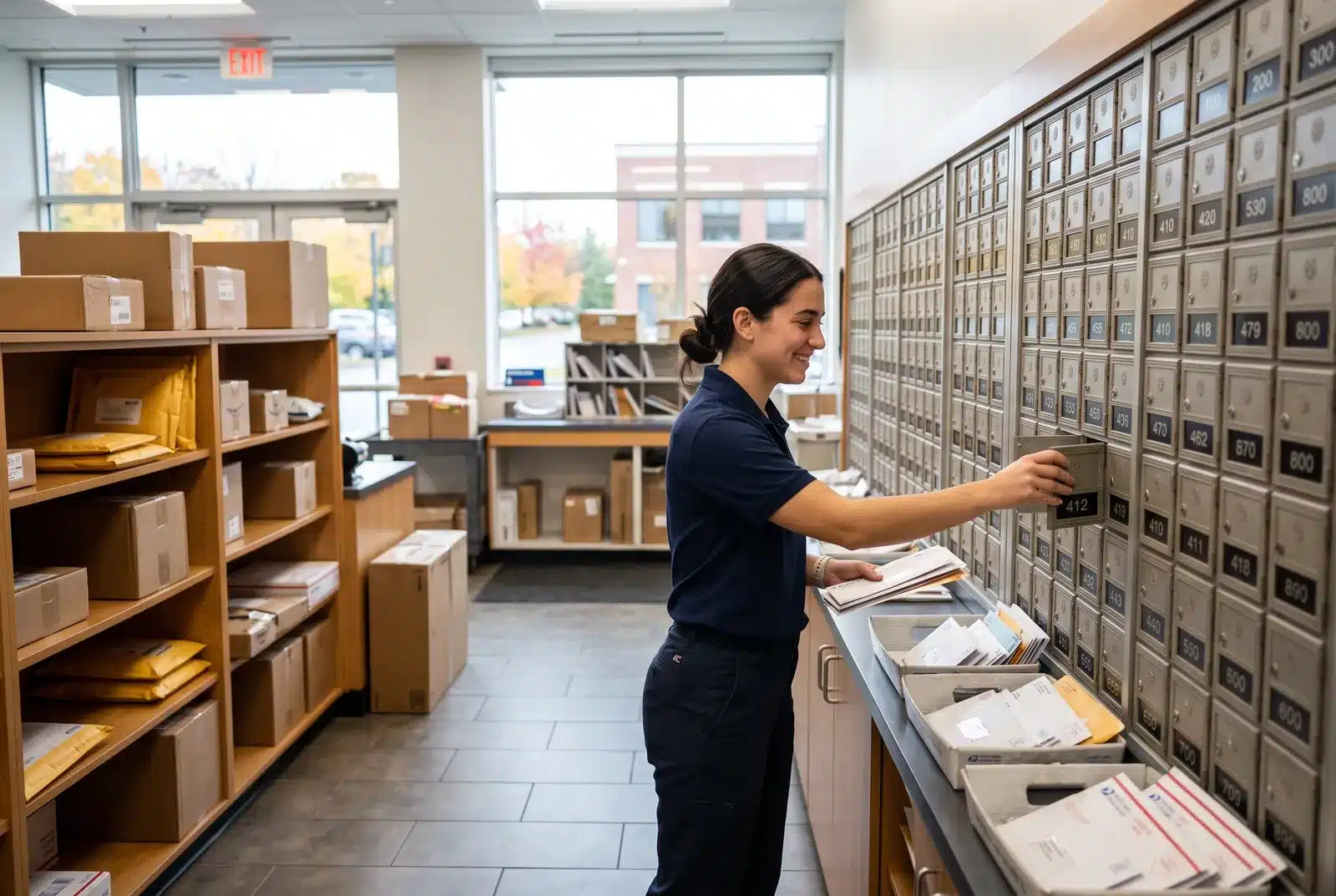
A virtual business address is a private mailbox at a commercial mail receiving agency, which the Postal Service calls a CMRA. The building is real. The staff are real. Your company gets a street address with a box number, and everything that arrives there is logged, photographed, and held for you. From an online account you decide what happens next: open and scan it, forward it, store it, or shred it.
The only “virtual” part is you. You aren’t sitting in the building. You manage the mail from a dashboard, from a home office in Lowell, a job site in Nashua, or an apartment in Lisbon.
That distinction matters because most of the rules you’ll run into are really about two things. Is the address a real street address (a PO Box isn’t)? And is there a human there to receive things? A staffed CMRA answers yes to both. An unstaffed “address” that only exists on paper answers no to the second, which is why a few systems, covered below, treat the two differently. If you want the regulatory background, our explainer on what a CMRA is walks through it.
Every CMRA customer, business or personal, signs USPS Form 1583 in front of a notary and shows two IDs. Your company name goes on that form too. That federal paper trail is the reason banks and government agencies treat these addresses as legitimate, and it’s also why you can’t open one anonymously.
The five address jobs every company has
Nearly every “can I use a virtual address?” question gets easier once you stop thinking of “the company address” as one thing. Your LLC or corporation has up to five jobs that need an address. The same address can do several of them, but the rules are set job by job.
Where lawsuits and state notices get served. Must be a physical street address in the state, with someone there during business hours.
Staffed service onlyWhere the state records your company as based. Public record. Usually has to be a street address, not a PO Box.
Virtual address usually fineWhere the bank, IRS, vendors and customers send paper. The most flexible job of the five.
Ideal for a virtual addressWhat goes on your website, invoices, contracts and email signature. A branding and privacy decision.
Ideal for a virtual addressSome filings ask where the people behind the company live. That’s personal, not corporate, and a mailbox can’t fill it.
Not a virtual address jobAssuming one rule covers all five. The registered agent rule (a person on site) doesn’t ban virtual addresses from the other jobs, and a mailbox being fine for mail doesn’t make it a registered agent.
The acceptance map: 16 places your company address shows up
This is the table we wish someone had handed us years ago. It lists the places a small company actually types its address, what they’re looking for, and whether a staffed virtual address works there. It reflects the rules and our customers’ experience as of 2026. Individual banks and agencies change policies, so treat the yellow rows as “confirm first.”
| Where the address goes | What they need | Staffed virtual address? |
|---|---|---|
| Secretary of State: principal office | A street address. PO Boxes are refused in most states. | Yes |
| Secretary of State: registered agent | In-state street address with a person present in business hours | Only if the facility is your designated agent |
| IRS EIN application (SS-4) mailing address | Where the IRS mails your notices | Yes |
| IRS address change (Form 8822-B) | Mailing address and responsible party details | Yes |
| State tax and payroll accounts (mailing) | Correspondence address | Yes |
| Business bank: statements and mail | Mailing address | Usually |
| Business bank: “physical address” field | Varies. Some banks and fintechs block CMRA addresses here. | Ask the bank |
| Payment processors and marketplaces | Business address plus document verification | Usually, verify first |
| Website, invoices, contracts, email footer | Anything professional and stable | Yes |
| Vendors, suppliers, customer checks | A place that can receive mail and packages | Yes |
| Business insurance | Mailing address, plus where operations actually happen | Mailing yes, disclose operations |
| Local business licenses and permits | Often the location where you operate | Depends on the town |
| Google Business Profile | A staffed location customers can visit, or a hidden-address service area | No, for an unstaffed mailbox |
| USPTO trademark “domicile address” | Your principal place of business, where the business is actually run | No as domicile, yes as mailing |
| FinCEN beneficial ownership report | Each owner’s residential street address | No for owners |
| Trade credit files and business directories | A consistent business address | Yes |
Two patterns jump out. The “yes” rows are about communication: where to send things. The “no” rows are about location or identity: where you really operate, or where a real person lives. Keep that split in mind and you can predict the answer for forms that aren’t on this list.
Want someone to check your setup? Tell us your state, entity type and what you’re filing. We’ll tell you which address goes where before you submit anything.
Ask our teamThe registered agent rule, explained without the legalese
Every LLC and corporation has to keep a registered agent on file in its state of formation, and in every state where it registers to do business. The agent’s job is narrow: be at a known street address during normal business hours so a process server or the state can hand over legal papers. Summonses, subpoenas, and official notices go there.
The rule exists because a lawsuit only moves forward fairly if the company can actually be told about it. If nobody is at the address when the process server shows up, the case can proceed without you, and a default judgment is a brutal way to learn what the requirement was for.
So can a virtual address be your registered agent address? It depends entirely on whether a person is there.
- An unstaffed mailbox or scan-only address: no. There’s nobody to accept service.
- A staffed facility that you formally name as your agent: yes. That’s exactly what a registered agent service is.
For Massachusetts companies, our Massachusetts registered agent service does this from the same Tewksbury office that handles your mailbox. Staff accept service during business hours, you’re notified right away, and the documents are scanned to you the same day. Your everyday mail comes in through your private mailbox number. It’s the same building, but these are two legal roles, set up with two separate designations. If you want the full statute, our guide to Massachusetts registered agent requirements covers it, and whether you can be your own registered agent covers the do-it-yourself route and its risks.
The four places a virtual address doesn’t work, and what to do instead
Honesty here saves you a rejected filing or a suspended listing. These are the four “no” rows from the map, with the workaround for each.
1. Google Business Profile
Google’s rules for Business Profiles don’t allow a listing at a virtual office or mailbox unless the location is staffed by your business during its stated hours. Listings at mailbox addresses tend to fail verification or get suspended later. If you’re a service business that goes to customers, a plumber or a consultant or a mobile notary, set up a service-area business and hide your address entirely. Google allows that, and your virtual address stays on your website and invoices where it belongs.
2. USPTO trademark filings
Since 2020 the Trademark Office has asked applicants for a “domicile address”: the principal place of business, where the company is actually run. A mailbox or a PO Box doesn’t qualify. The good news is that the USPTO lets you give a separate mailing address that shows publicly, and it keeps the domicile address hidden from the public record if you mark it that way. Your virtual address goes in the mailing field, and your actual base goes in the domicile field.
3. Beneficial ownership reports (FinCEN)
The federal beneficial ownership report asks for each owner’s residential street address. After FinCEN’s March 2025 rule change, US-formed companies are exempt, and the reporting duty now falls mainly on foreign companies registered to do business in the US. If your company still has to file, owner addresses must be where the owners live. The company’s own address can still be your virtual one.
4. Anything that asks where you physically operate
Some local business permits, zoning questions, certain insurance applications, and bank “physical location” fields want the place the work happens. Answer those truthfully, which for a home-based company usually means the home address in a field that isn’t published. Use the virtual address everywhere the form asks for a mailing or business address. Our guide on a business mailing address for a home-based business goes further on keeping your home off public records.
Banks, fintechs and the CMRA flag
Here’s something most guides leave out. The Postal Service’s address database marks every CMRA address with a flag. Banks, card issuers, and fintech apps can see that flag when they check your address, often automatically during the application.
What they do with it varies a lot:
- Most traditional banks accept a CMRA address as the business mailing address without fuss, especially when you open the account with a banker.
- Some online banks and fintechs block CMRA addresses in the primary address field, or ask for a second document tying the business to a physical place.
- Nearly all banks want the residential address of each owner and signer as part of identity checks. That’s normal and separate from the business address.
Our advice after years of watching customers go through this: ask the bank before you apply, “Can the business mailing address be a private mailbox at a CMRA?” Put the virtual address in the mailing field and answer every “physical” question truthfully. If you’ve already been turned down, our guide to what to do when a bank rejects a virtual mailbox address lists the fixes that usually work. Founders running US banking from overseas should also read keeping a US bank account while living abroad.

LLC vs corporation: what actually changes
For the address question, less than people expect. Both entity types have the same five address jobs, and a virtual address fills the same ones. The differences show up in paperwork:
| LLC | Corporation (S or C) | |
|---|---|---|
| Formation filing | Certificate of organization (name varies by state) | Articles of organization or incorporation |
| Addresses on the filing | Principal office, registered agent. In Massachusetts, also the business address of each manager and an in-state office where records are kept. | Principal office, registered agent, often officer and director addresses |
| Annual report | Principal office and agent, sometimes managers | Principal office, agent, and officer and director names and addresses |
| Where the virtual address helps most | Keeps a single owner’s home off the certificate and annual reports | Keeps officers’ and directors’ homes off annual reports where a business address is allowed |
| Multiple entities | Holding company plus operating LLCs can share one mailbox | Parent and subsidiaries can share one mailbox |
For corporations, the privacy benefit is often bigger. Annual reports that list officers and directors are public and get scraped by data brokers. Where your state lets you give a business address for officers, a virtual address keeps five people’s homes out of those databases instead of one. Massachusetts owners can go deeper in our guide to a virtual address for a Massachusetts LLC.
Does it depend on your state?
People search “virtual address for LLC in Florida” or “Texas” or “California” as if each state had a different answer. In practice the pattern is almost identical everywhere:
- Every state requires a registered agent with a physical street address inside the state.
- Nearly every state refuses a PO Box as the principal office but accepts a street address, and a CMRA address is a street address.
- No state we know of bans a CMRA address as the company’s mailing address.
What does vary is the small print: whether the state wants manager, member or officer addresses, whether it asks where the records are kept, and how local licensing works. Check the form itself before filing. If you’re outside Massachusetts, our mailbox still works as your mailing and principal office address. You’ll just use a registered agent in your own state.
A common setup for out-of-state founders: a company formed in its home state, which then registers in Massachusetts as a “foreign” entity because it hires, rents, or sells here. That foreign registration needs a Massachusetts registered agent, and many owners want an in-state address anyway. Our Massachusetts registered agent requirements guide covers how foreign LLCs handle that designation.
Is there a free virtual address for an LLC?
Search volume says a lot of founders hope so. Here’s the honest rundown of the “free” options and what they cost you in other ways:
Free Legal almost everywhere. But it becomes public record, gets copied by data brokers, and has to be amended every time you move. Amendments fix the state record, not the copies.
Free, risky Works until they move, get tired of your mail, or miss a legal notice. It also ties your company to their home in public records.
Limited Often covers legal service only. Many of these services don’t accept your everyday mail or packages, or charge per item.
Cheap, wrong tool Not free, not a street address, refused on most formation filings, and can’t take packages from UPS or FedEx. Our virtual mailbox vs PO Box comparison explains why.
A paid virtual address earns its cost when privacy, stability, or package handling matter to you. If none of them do, your home address is a legitimate choice. Just make it a deliberate one, because it’s hard to undo.
What it costs, compared with the alternatives
Our plans are priced by mail volume and storage. Every annual term includes a bonus month, so you get 13 months of service for a year’s payment. Postage is only charged when you forward something.
- Starter: $330 a year ($82.50 quarterly or $165 semiannually), 30 days of free storage. Suits a side business with light mail.
- Silver: $450 a year ($112.50 quarterly or $225 semiannually), 60 days of storage and free package consolidation. The usual pick for small companies.
- Gold: $595 a year ($148.75 quarterly or $297.50 semiannually), 90 days of storage, up to 5 cubic feet, and free consolidation. Built for package-heavy businesses.
How that compares with other ways of getting a business address, using typical Greater Boston market ranges for the alternatives:
The rule of thumb: if you meet clients on video and rarely in person, the mail layer is all you need. If you host clients in person every week, a virtual office bundle might be worth it. For how providers pad the base price with per-scan and per-item fees, see our virtual mailbox cost breakdown.
A 60-second decision path
- Do you need somewhere to receive mail and packages that isn’t your home? If not, and you’re comfortable with your home address being public, you may not need any of this.
- Is your company formed or registered in Massachusetts? If yes, add our registered agent service and the mailbox together. If no, keep your current agent in your formation state and use the mailbox for mail and the principal office.
- Do you have a storefront customers visit, or do you need to rank in Google Maps? If you serve customers at their location, set up a service-area Business Profile with the address hidden. A walk-in location needs its real address.
- Do you file trademarks? Give the real base as the domicile, marked private, and the virtual address as mailing.
- Opening a bank account soon? Ask the bank about CMRA addresses first, then apply with the virtual address as the mailing address.
- How much mail and how many packages? Light letters: Starter. Regular packages: Silver. Inventory or samples: Gold.
Setup, in the order that avoids refiling
The order matters more than people think. Each step below asks for something from the step before it. Founders who use a temporary address “for now” end up updating the state, the IRS, the bank, and every vendor a second time.
- Get the address first. Pick a plan on our plans page. If you’re forming in Massachusetts, add registered agent service at the same time.
- Complete USPS Form 1583. List yourself and every company that will get mail there, including the LLC you’re about to form and any holding company. Notarize it in person or online, from anywhere in the world. Our application guide shows each field.
- File formation paperwork using the mailbox as the principal office and mailing address, and our office (or your state’s agent) as registered agent.
- Get your EIN with the same mailing address, written exactly the same way.
- Open the bank account, having asked first about CMRA addresses.
- Roll it out: website footer, invoices, payment processor, suppliers, insurance. Keep the format identical everywhere.
- Decide your mail rules: what gets scanned automatically, who on your team has access, and how often packages get consolidated and forwarded.
Already formed with your home address? You’re not stuck. File a change of address with the state, send the IRS Form 8822-B, and update the bank. It’s more steps than starting clean, but the public record moves forward from there. Our walkthrough on changing your registered agent in Massachusetts covers the agent side.
Three setups we see every month
These are composites of situations that come up again and again. Names and details are blended so no single customer is identifiable, but the problems and the fixes are real.
The consultant who was tired of strangers at her door
A marketing consultant formed a single-member LLC with her home address because it was the fastest option. Two years later a prospect she’d turned down showed up at her house to “talk it over.” She moved the principal office and mailing address to her mailbox, added our registered agent service, and switched Google to a service-area profile with no address shown. Her address still sits in old data-broker copies, but new filings don’t add to it, and every consultant in this spot tells us the same thing: they wish they’d started that way.
The Canadian founder selling to US customers
A Canadian founder formed a US LLC to sell on American marketplaces. He needed a US address before anything else would work: EIN letters, bank account, seller account. He signed Form 1583 by online notary from home in Canada, had an address the next business day, and used it in that order. Returns from US customers now come back to his box and get consolidated monthly instead of crossing the border one at a time. Our guide to a US address for international online sellers is built around this path.
The family business with three entities
A family runs a holding company, an operating LLC, and a real estate LLC. They used to have mail scattered across two homes and a relative’s office. Now all three companies are listed on one Form 1583 and share one box. Checks for any of them arrive in one place and get scanned the same day. That’s far cheaper than an address per entity, and the bookkeeper works from PDFs without keys to anything.
Running more than one company? One mailbox can hold mail for every entity you list on Form 1583, at no extra plan cost.
See business mailboxesWhat day-to-day life looks like with a virtual business address
The real benefit shows up on an ordinary Tuesday. A customer check arrives and you get an email within minutes, not at the end of a week of mail piling up. You order a scan, confirm the amount, and deposit it by mobile if your bank supports that. A vendor invoice gets scanned and sent to your bookkeeper. A state notice or annual report reminder shows up as a PDF instead of vanishing into a kitchen drawer. Junk mail gets shredded before it reaches you.
Packages from any carrier, including UPS, FedEx, DHL, Amazon and USPS, are signed for and stored: 30, 60 or 90 days free depending on plan. When you want them, you forward them from the dashboard to anywhere in the US or to 220+ countries. Mail security is part of it too. Business checks sitting in an unlocked curbside mailbox are exactly the risk our guide on preventing mail theft and check fraud warns about, and a staffed facility removes it. Our mail scanning service page shows how the scanning side works.
Mistakes that cost founders time and money
- Putting a PO Box on formation papers. Most states reject it, and the fix costs you filing time.
- Naming yourself registered agent at an address where nobody is during the day. The process server comes at 11 a.m. on a Tuesday. You’re at a client site.
- Leaving the company off Form 1583. Mail addressed to the LLC then needs manual matching. List every entity from the start.
- Writing the box number three different ways. “Suite,” “Unit,” “#,” “PMB”: pick the format we give you and use it everywhere.
- Listing a mailbox on Google Business Profile. It’ll likely fail verification or be suspended. Use a service-area profile.
- Letting the registered agent lapse. Continuous coverage is required. A lapsed agent can knock the company out of good standing.
Frequently asked questions
Can an LLC use a virtual address as its business address?
Yes. A virtual address at a staffed CMRA is a real street address, so it works as the mailing address, the public business address, and in most states the principal office on formation documents. The registered agent designation has a separate staffing rule.
Can a corporation use a virtual address?
Yes, in the same way as an LLC. Corporations often get more privacy value from it, because annual reports list officers and directors, and a business address keeps their homes off public filings where the state allows it.
Can a virtual address be my registered agent address?
Only if the facility is staffed during business hours and formally designated as your registered agent. Our Tewksbury office does this for Massachusetts companies. An unstaffed or scan-only address doesn’t qualify.
Will the IRS accept a virtual address for my LLC?
Yes, as the mailing address on your EIN application or on Form 8822-B for a change. Tax residency and state tax questions follow separate rules, so talk them through with your tax professional.
Can I use a virtual address on Google Business Profile?
Not for an unstaffed mailbox. Google requires a staffed location for a listed address. If you serve customers at their location, set up a service-area business with your address hidden.
Can I use a virtual address for a trademark application?
As the mailing address, yes. As the domicile address, no. The USPTO wants your principal place of business there, and it lets you keep the domicile address out of the public record.
Is there a free virtual address for an LLC?
Not a real one with staffed mail handling. The free options are your home address, a friend’s address, or the limited address a registered agent includes, each with trade-offs in privacy and stability.
Can several LLCs share one virtual address?
Yes. List each company on your Form 1583 and mail for all of them arrives in the same private mailbox, at no extra plan cost.
How fast can I get the address?
Usually within one business day of your notarized Form 1583 and IDs being approved. Online notarization means you can finish from anywhere.
Give your company an address you’ll never have to change
We’ve been handling mail for Massachusetts businesses and founders around the world since 2007, from a staffed, USPS-registered facility in Tewksbury. Pick a plan, add registered agent coverage if your company needs it, or call (978) 851-0199 and describe your setup. We’ll tell you which address goes where.
See plans and pricingAdd a registered agentRelated guides
